There is a moment on inspections in the post-war suburbs around Philadelphia that plays out the same way nearly every time. I open the panel door, read the label, and the buyer standing next to me reads my face before I say anything.
Two brands account for most of it: Federal Pacific and Zinsco. They get written up on inspection reports far more often than any other panel, and buyers are frequently told about them for the first time on inspection day, with a contingency clock already running.
Standing at the panel, I explain what these are, why the industry treats them differently from an ordinary old panel, and what to actually do about it.
How to Tell What You Have
You can check this yourself without touching anything dangerous. Open the panel door, the outer door, the one with the directory taped inside it, and read the label. You do not need to remove the inner cover, and you should not. That inner panel, the dead front, is what stands between you and live bus bars.
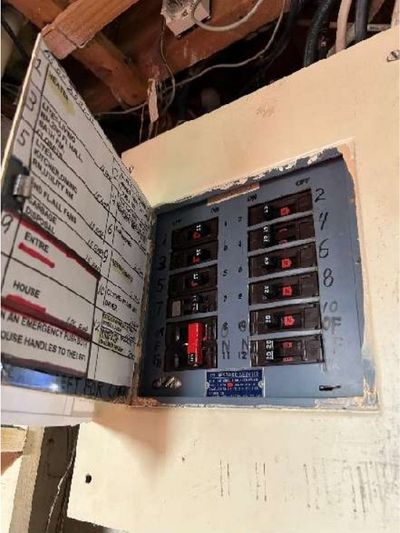
Federal Pacific panels are typically labeled Federal Pacific Electric or FPE. The breakers are usually marked Stab-Lok, and many carry a distinctive red stripe across the handle. These were installed heavily from the 1950s into the early 1980s.
Zinsco panels are labeled Zinsco or Sylvania-Zinsco. The visual tell is the breakers: handles in several different colors sitting in a row, which looks unusual once you have seen a few conventional panels.
What the Actual Concern Is
There is a lot of loose talk about these panels, and buyers deserve the real version.
Federal Pacific Stab-Lok
The documented concern is specific: independent testing has found that Stab-Lok breakers can fail to trip when they should. A breaker exists to interrupt current during an overload or short circuit. A breaker that does not open during a fault leaves that current flowing in the circuit it was installed to protect.
The Consumer Product Safety Commission investigated Federal Pacific in the early 1980s. In 1983 it closed the investigation without issuing a recall, and the stated reason was that the agency lacked the resources to establish the case, not a finding that the panels were safe. That distinction matters. "No recall" is frequently repeated as though it were an all-clear. It was not one.
Decades later, the industry position has hardened rather than softened, which is why you will find home inspectors across the country flagging these panels consistently.
Zinsco
Zinsco's issue is mechanical and it is visible more often. The breakers connect to an aluminum bus bar, and over decades that connection can degrade and overheat. In the worst cases the breaker effectively welds itself to the bus, at which point the handle can be moved to "off" while the circuit behind it stays energized. A breaker that appears to be off but is not is a genuinely hazardous condition for anyone doing work on that circuit.
Unlike the Federal Pacific concern, Zinsco degradation frequently leaves evidence I can see: scorching, discoloration, corrosion, or heat damage on the bus and around the breaker stabs.
"It Has Worked Fine for Forty Years"
Sellers say this, listing agents say this, and it is the most reasonable objection anyone raises. It deserves a straight answer rather than a brush-off.
The problem is that the failure mode does not appear during normal use. A circuit breaker that never has to trip functions indefinitely. Under normal load it is just a switch, and it will switch. The concern is entirely about what happens during the fault event the breaker was installed to handle.
So forty uneventful years tells you the protection has not been tested. It does not tell you the protection works. Those are different statements, and the difference is the entire issue.
Obsolete Is Not the Same as Unsafe
I flag a lot of old panels that are not Federal Pacific or Zinsco, and I try to be careful not to let the two categories blur together, because buyers end up paying for that confusion.
Plenty of panels in this region are simply obsolete: discontinued brands where replacement breakers are hard to source, or panels that are undersized for how the house is used now. That is a real finding with real consequences, but the consequence is inconvenience and capacity, not a documented breaker failure mode.
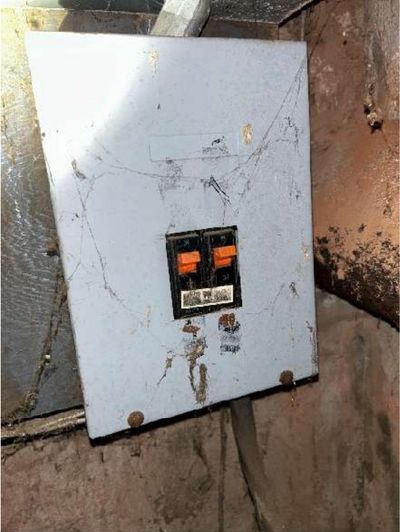
A 60-amp service is a good example. It is not dangerous by itself. It is simply not enough for central air, a modern kitchen, and a house full of electronics, and it will constrain what you can do with the property. I write it up as what it is.
Being honest about that distinction matters. An inspector who describes every old panel as a fire hazard has made their findings useless. Once everything is an emergency, buyers cannot tell which item actually is.
What Replacement Costs Around Philadelphia
I am an inspector, not an electrical contractor, so the real number comes from a licensed electrician who has seen the installation. With that said, buyers need a working figure to negotiate against.
In this region, a straightforward panel replacement commonly runs roughly $2,000 to $4,000. What pushes it higher:
- Service upgrade at the same time. Going from 100 to 200 amps is a bigger job than swapping the panel.
- Service entrance cable, meter socket, or grounding needing work. These are commonly found together, since they are the same vintage.
- Utility involvement. If the service drop or meter has to change, PECO's schedule becomes part of your timeline.
- Location. A panel in an open basement is straightforward. One in a finished wall means opening and patching.
Compared with most findings that surface at inspection, this is a mid-range, well-defined, one-day job with a predictable price. That makes it one of the more negotiable items on a report, provided you have a quote rather than a guess.
Where These Turn Up Around Philadelphia
These panels track the building boom that installed them, which means the post-war and mid-century suburbs. I find them regularly through Bucks County: Levittown, Warminster, Bensalem, Feasterville, and Southampton, where enormous numbers of homes went up between the late 1940s and the 1970s.
Montgomery County's post-war communities are the same picture, including Willow Grove, Horsham, and Abington. In Delaware County I see them across Drexel Hill and Springfield.
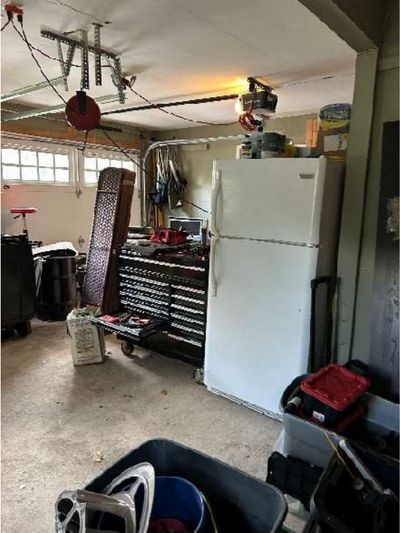
One pattern worth knowing: in homes where the main panel was replaced at some point, the sub-panels frequently were not. Garages, additions, and finished basements often still hold the original equipment. I check them all, because the upgraded main panel is exactly what makes people stop looking.
What To Do If Your Inspection Finds One
If your inspection report identifies a Federal Pacific or Zinsco panel, the work to do is straightforward and the whole of it belongs inside your inspection contingency period, because that window is the only time the cost is negotiable. Handle it in this order.
- Get an electrician's quote in writing. Not a phone estimate. A quote from someone who has looked at the installation.
- Call your insurance agent the same day. Carriers differ, and some impose conditions. Find out before your leverage expires, not after.
- Negotiate with the number. A defined, priced, one-day job is among the most straightforward things to negotiate on any inspection report.
- If you keep it for now, treat it as scheduled work. Some buyers absorb the cost and replace after closing. That is a legitimate choice, as long as it is a decision with a date on it rather than something that quietly becomes permanent.
What I would not do is ignore it because the house has been standing a long time. Longevity is not evidence about equipment whose whole purpose is to perform during an event that has not happened yet.
The Bottom Line
A Federal Pacific or Zinsco panel is not a reason to walk away from a house. It is a known condition with a known remedy and a fairly predictable price, which puts it in the best category a major inspection finding can be in.
The buyers who get hurt are the ones who never learned which panel they had, because nobody opened the door and read the label, or because the report said "aged electrical panel" and left it there.
I open and photograph every accessible panel on every inspection, main and sub, and I tell you plainly which category yours falls into. If you are under contract anywhere in the Philadelphia region, call or text me at 610-348-6728. I do every inspection myself, and you will hear the answer from the person who actually looked.
Home Inspection in Post-War Philadelphia Suburbs:
Levittown Warminster Bensalem Willow Grove Horsham Abington Drexel Hill Yardley