Over 20+ years I have inspected attics across the Philadelphia suburbs: Wyncote, Jenkintown, Cheltenham, Hatfield, Lansdale, and beyond. In that time, I've found something that surprises most homeowners: attic mold is everywhere.
Not everywhere, of course. But it's far more common than people realize, and it's far easier to miss than most people think. The attic is dark, insulated, and hard to access. Many homeowners never go up there. And by the time mold becomes visible, it's often been growing for months or even years, silently damaging roof sheathing and framing.
Attic mold is common in older Philadelphia-area houses. Nearly half of Montgomery County homes were built before 1970, when attic ventilation requirements were far less stringent than today, which means attic mold risk is baked into the age of the housing stock here, including the older neighborhoods around Norristown and Abington.
I personally perform every attic inspection and air quality test in the Philadelphia region. And I want every homeowner and buyer to understand what attic mold actually looks like, because the pictures matter more than the description.
What Attic Mold Looks Like
When you first see attic mold in a real inspection, it's striking. It's not fuzzy green or black growth in a petri dish. It's dark staining, often deep gray to black discoloration, on the underside of the roof sheathing (the plywood decking that the roofing is fastened to). It follows the pattern of the roof framing: the ridge board, the rafters, the collar ties.
Look at this photo from a recent inspection in the Philadelphia suburbs:
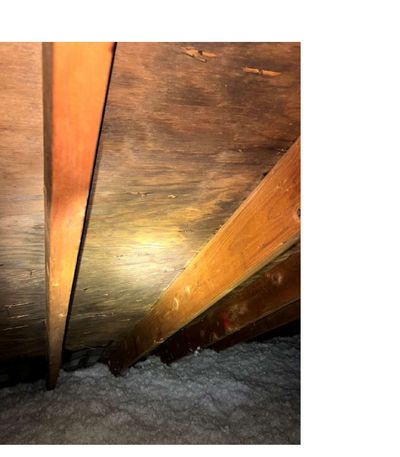
That's what active attic mold looks like. Not fuzzy growth. Not the obvious black splotches you see in horror-story mold photos. Just dark staining on plywood that tells you something is wrong with the moisture levels above your head.
Stachybotrys, the so-called "toxic black mold," typically requires sustained moisture for 8 to 12 days before visible growth appears, but Cladosporium and Penicillium can establish in as few as 24 to 48 hours given the right conditions. There is no federal spore-count limit. An attic air sample is read against an outdoor sample taken the same day, and an indoor count well above outdoor levels, or water-damage types like Stachybotrys or Chaetomium, points to active growth even when nothing is visible.
In older homes or homes with more advanced mold growth, the staining can be more extensive, covering larger areas of sheathing, sometimes following stripe patterns that indicate where moisture is being driven by roof structure and ventilation.
How does mold get into your attic in the first place?
Mold grows where moisture and darkness and temperature converge. Attics have darkness and temperature covered. The moisture part: that's what you need to understand.
There are five main ways moisture gets into your attic in a typical Philadelphia-area home:
Bathroom and kitchen fans vented into the attic. This is the number one cause I see. Your bathroom exhaust fan is designed to pull humid air out of the bathroom. In many older homes, and in some newer ones where shortcuts were taken, that ductwork doesn't vent all the way to the outside. It terminates in the attic. Every time you shower, warm, humid air is dumped directly into the attic space. Multiply that by weeks and months, and you've created an ideal environment for mold.
Condensation from temperature differences. In winter, warm air rises from the living space into the attic. If the attic has poor insulation or air gaps, that warm air meets the cold roof sheathing. Moisture condenses on the cold surface, just like it condenses on a cold window. That condensation drives mold growth, particularly on north-facing sheathing, which stays cooler and dries more slowly. Over a Pennsylvania winter, this can create significant moisture accumulation on attic framing and sheathing.
Small roof leaks. It doesn't take much. A cracked shingle, a failed flashing, deteriorating caulking around a vent: any of these can allow rain to seep into the rafter bays. A roof older than 20 years has a significantly higher risk of the small, slow leaks that initiate attic mold colonies, and many of the Philadelphia-area homes I inspect have roofs in that age range or older. Unlike a dramatic roof leak that you'd notice immediately, a slow leak can persist for months before you see evidence in the living space below.
Ice dam damage. This is a big one in the Philadelphia region. When snow melts on a roof and refreezes at the eaves, it creates an ice dam that backs water up under the shingles. That water runs down into the fascia and into the attic framing. A single bad winter can introduce moisture that takes months to dry.
Gaps in vapor barriers and poor insulation installation. If the ceiling vapor retarder under your attic insulation has tears, gaps, or was never installed properly, warm humid air from the living space can migrate up into the attic. A properly ventilated attic should provide 1 square foot of net free ventilation area for every 150 square feet of attic floor. Without adequate airflow to remove that moisture, it accumulates and condenses on roof sheathing.
The common thread: moisture. Attic mold is always a symptom of a moisture problem. Fix the moisture problem, and you eliminate the conditions for mold. Ignore it, and mold keeps growing.
What does the pattern of attic mold staining tell you about the moisture source?
One of the most useful things I've learned in 20+ years of attic inspections is this: the pattern of discoloration tells you what caused the moisture problem. And that matters, because it tells you how to fix it.
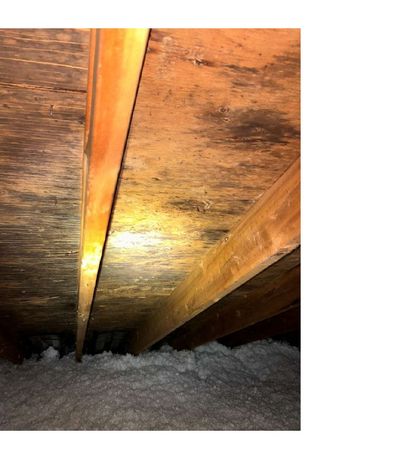
Look at that second photo. Notice how the staining follows a specific pattern on the sheathing. That pattern is diagnostic.
If mold is concentrated along the ridge line and upper roof slopes, you're often looking at condensation: warm attic air meeting cold roof sheathing at the peak of the roof.
If mold staining follows the path of a single rafter or runs down from a particular location on the roof, that's typically a localized leak.
If the staining is more uniform across a larger area, you're likely looking at condensation from ambient humidity, vapor migration, or a poorly vented bathroom/kitchen exhaust fan.
This pattern diagnosis is valuable because it guides remediation. You can't fix mold without fixing its cause. And you can't fix the cause if you don't know what it is. Skipping proper diagnosis is how homeowners end up spending $3,000 on remediation only to have mold return within 12 months because the exhaust fan was never rerouted outside.
What does lab testing reveal about attic mold that visual inspection misses?
Lab testing answers the question visual inspection can't: how bad is this, and has it spread beyond what you can see? When I find visible mold staining in an attic like the one in these photos, I perform both surface testing (to confirm the mold type and rule out lookalikes like dirt or wood-tannin staining) and air sampling, because visible growth is only part of the picture. Spores from that staining have often already migrated into the air above your head, and surface testing alone won't tell you that.
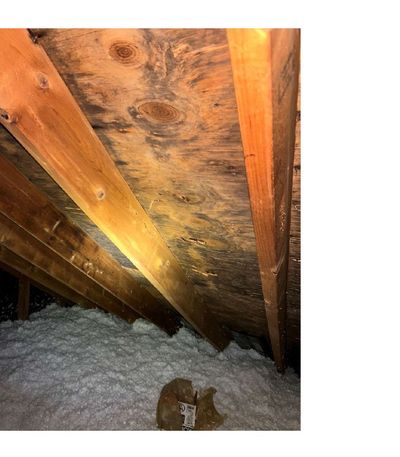
The inspection that produced these photos, from a home in the Philadelphia suburbs above a master bedroom, gave these results:
PRO-LAB certified air sampling for an attic starts at $290 and provides results within 2 to 3 business days from an accredited independent laboratory. That cost is a fraction of what remediation runs if a problem is left to grow.
The air samples from the attic showed mold spore levels that were NOT elevated compared to the outdoor baseline. That was important news. It meant spore levels in the upper attic were not dangerously high.
But the surface swab from the mold staining on the sheathing came back UNUSUAL. That's PRO-LAB's way of saying: this is active growth, and it's a mold type that indicates a moisture problem.
This distinction matters. I'll say it again because it's critical: you can have active mold growth and not have elevated air spore levels. You can have low air test results and still have an active problem that needs remediation.
Why? Air sampling tells you about the concentration of floating spores. Surface sampling tells you whether there's active growth. They measure different things. And this home had active growth on the sheathing that hadn't yet filled the entire attic with spores.
That's actually the best time to catch attic mold: after active growth has started, but before it's reached massive concentrations. Early detection means smaller remediation scope and lower cost. Attic mold remediation in the Philadelphia area typically costs $1,500 to $5,000 for early-stage surface treatment; cases involving replacement of sheathing, insulation, and structural framing can push that figure to $10,000 or more.
Why does attic mold matter even if you never go up there?
A lot of homeowners' first reaction to finding attic mold is: "Okay, but I don't go up there. Does it really affect me?"
Yes, for several reasons.
Mold spores migrate downward. The air in your attic is connected to the air in the rest of your home. Spores don't respect walls and ceilings. Ceiling cavities, gaps around ceiling fixtures, HVAC returns that pull air from the attic: these all create pathways for spores to enter the living space. This is especially true in older homes where air sealing is minimal.
HVAC systems can distribute spores throughout the home. If your furnace or air handler is in the attic, or if return air ducts pull from the attic space, mold spores are being circulated through every room in your house. This is a particular concern in finished attics or homes with attic-mounted HVAC equipment.
Structural damage happens slowly but relentlessly. Surface mold itself does little to the strength of wood, but the moisture that feeds it also feeds wood-decay fungi, which do break wood down. Sheathing that stays wet enough to grow mold season after season is at real risk of rot, and rot can compromise the structural integrity of the roof system.
The longer you wait, the more expensive remediation becomes. This is straightforward: small mold problems are inexpensive to address. Large mold problems are expensive. If you catch mold early, you do surface remediation and fix the moisture source. If you wait, you're replacing sheathing, replacing insulation, replacing rafters, and the cost multiplies.
What should every homeowner check in their attic for mold risk?
You don't need to be an inspector to recognize warning signs. Here's a simple checklist for the next time you're in your attic:
- Look for dark staining on roof sheathing. Grab a flashlight and look up at the underside of the roof. Any dark gray or black discoloration? That warrants closer inspection and possibly professional testing.
- Check that all exhaust fans vent outside. Follow your bathroom and kitchen exhaust ducts. Do they go all the way outside the home, or do they terminate in the attic? If they terminate in the attic, that's a moisture source that needs to be corrected immediately.
- Feel for moisture on surfaces. Touch the roof sheathing, the rafters, the insulation. Is anything damp or soft? Wet insulation has lost its R-value and indicates active moisture.
- Look for ice dam staining or water marks. After winter, check for evidence of water seepage. Any brown staining or water marks on sheathing or framing indicate where water has been running.
- Evaluate ventilation. Do you see ridge vents, soffit vents, gable vents, or other ventilation openings? Is the soffit venting blocked by insulation? Proper attic ventilation is your primary defense against condensation and moisture accumulation.
If any of these raise a concern, that's when to call a professional. A PRO-LAB certified air quality test can give you objective data about what's happening in your attic, whether you can see it or not. I typically collect 3 samples per attic inspection: 1 outdoor baseline, 1 main attic air sample, and 1 surface swab from any suspicious staining, giving you both a comparative baseline and direct evidence about what mold types are present.
What is the most important thing to know about finding and fixing attic mold?
Attic mold is preventable, testable, and treatable, and early detection is the whole game. The difference between a minor ventilation correction and a full remediation is usually nothing more than how long the moisture sat undetected. That gap is why an attic is worth checking on a schedule rather than waiting for the problem to announce itself.
If you own a home in the Philadelphia area, especially an older home, include your attic in your maintenance mindset. Make sure exhaust fans vent outside. Ensure adequate ventilation. Address roof leaks promptly. And if you notice any warning signs, don't wait for a problem to become obvious. An annual attic inspection costs far less than the $5,000 to $15,000 remediation bill that results from catching a problem late.
I personally perform every attic inspection, air quality test, and mold assessment in the Philadelphia region. I use PRO-LAB certified testing labs for all samples, so your results come from an accredited independent laboratory, not from my assumptions or visual judgment alone. Results are typically in your hands within 2 to 3 business days of sampling.
Questions about what you've read? Concerned about your attic? Ready to schedule an inspection? Call me directly at 610-348-6728. I answer my own phone and can discuss your specific situation in detail.
Need Professional Mold Testing?
All Seasons provides PRO-LAB certified mold testing and air quality analysis across the Philadelphia region and South Jersey. Owner-operator Bob personally collects all samples. Results in 2-3 days. Call 610-348-6728 for a free estimate.
Attic Mold Testing by Area:
Philadelphia Norristown Cheltenham Ardmore Upper Darby Abington Willow Grove