In early May 2026, a homeowner in Elkins Park called All Seasons before putting their home on the market. They had noticed something they'd been brushing off for a while: a white, chalky crust spreading across the lower half of a stone foundation wall in the basement. There was also a faint but persistent musty smell. They wanted to know what they were dealing with before a buyer's inspector found it.
What followed was a good example of why trusting your instincts, and getting lab results before making assumptions, matters in an older home.
What the On-Site Inspection Found Before Sampling
The pre-1940 stone foundation basement showed several converging signs of long-term moisture intrusion. The white deposits on the lower foundation walls were efflorescence, mineral salts left behind as groundwater pushes through masonry and evaporates on the interior surface. Efflorescence by itself doesn't confirm mold, but it confirms a moisture pathway through the wall.
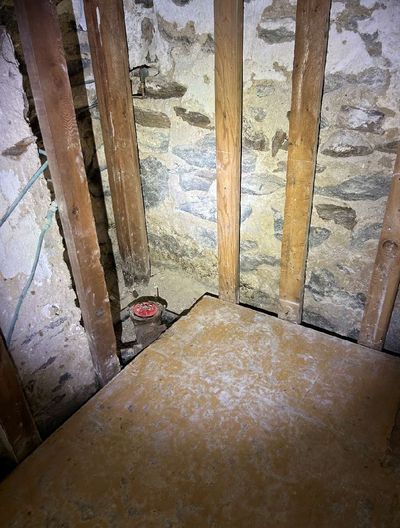
Beyond the efflorescence, there was water staining on the underside of the first-floor joists, consistent with past moisture rising from the basement environment. Multiple areas of the basement showed evidence of past water infiltration. The musty odor was present throughout the space.
These signs together pointed strongly toward elevated mold concentrations, but visual inspection alone cannot identify what's growing. That's what the air sampling is for.
How PRO-LAB Air Sampling Works
PRO-LAB certified air sampling uses spore trap cassettes, small devices that draw a measured volume of air across a sticky surface, trapping any airborne mold spores present. The critical part: one cassette goes inside the affected area, and a second goes outside as a control sample, taken from fresh outdoor air away from the foundation.
The cassettes go to the PRO-LAB facility for analysis. Lab technicians examine them under microscopy, identify the mold spore types present, generally to the genus level, and count concentrations. The comparison between indoor and outdoor samples tells the real story: if indoor Stachybotrys concentrations are elevated relative to the outdoor control, there is an active indoor mold source. If indoor and outdoor counts are similar, what you're seeing may be normal background spores from outdoor air entry.
In this case, the comparison was not ambiguous.
What the Lab Found: Stachybotrys Confirmed
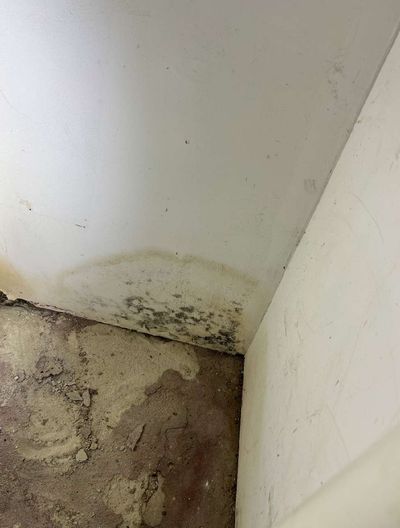
PRO-LAB results confirmed Stachybotrys spores at elevated concentrations in the basement air sample relative to the outdoor control. The outdoor sample, taken from the same property on the same day, showed normal background levels. The indoor-to-outdoor differential was the definitive finding: there was an active Stachybotrys colony in this basement.
Stachybotrys requires sustained, continuous moisture to grow. It cannot establish itself from a brief water event. The confirmed presence of Stachybotrys told us that this basement had been maintaining a wet-enough environment, long enough, for one of the most demanding molds to colonize. That is not a cosmetic finding.
What Stachybotrys Means, and Why It's Not a DIY Situation
Stachybotrys chartarum is the mold species most commonly called "black mold." It can produce trichothecene mycotoxins, but the CDC says no test proves an association between Stachybotrys and particular health symptoms, and that all molds should be treated the same with respect to health risks and removal.
The EPA recommends that mold-affected areas exceeding 10 square feet be handled by professional remediation contractors. Stachybotrys specifically should not be disturbed without proper containment and respiratory protection. Disturbing a colony releases spores and toxins into the breathing zone. Household bleach does not work on Stachybotrys in porous materials like stone and wood because it cannot penetrate the surface; it removes the color while leaving the root structures intact.
This is a call a licensed mold remediation contractor, not a call for a can of Kilz.
Why Stone Foundations in Elkins Park Are Especially Vulnerable
The home in this case is typical of Elkins Park's housing stock: built in the 1920s or 1930s, with stone-and-mortar foundation construction and no waterproofing membrane. Waterproofing membranes weren't standard practice until the 1970s; homes built before that era rely on the masonry itself to resist groundwater pressure.
As mortar joints age, they deteriorate. Freeze-thaw cycling over 80-90 winters widens gaps in the pointing. The Tookany Creek watershed creates seasonal groundwater pressure patterns across Cheltenham Township, Elkins Park, Wyncote, LaMott, and Melrose Park, that push groundwater against foundation walls in wet seasons. When those mortar joints are compromised, water finds its way through.
This pattern is not unique to the property in this case. If you own or are buying a pre-1960 home in Elkins Park or a neighboring community like Glenside or Jenkintown with a stone or brick foundation, baseline mold testing is worth doing, not because mold is certain, but because it's common enough that knowing for sure is better than assuming.
What Happened Next
With Stachybotrys confirmed, a professional mold remediation contractor was engaged. The scope of affected material, including visible growth, water-stained joists, and the extent of the moisture-affected area, exceeded the EPA 10 square foot threshold for professional remediation. The project required proper containment, HEPA air filtration, controlled removal of affected materials, and careful disposal.
Post-remediation clearance sampling was recommended before closing or occupancy, a second round of PRO-LAB air sampling after remediation is complete to confirm spore concentrations have returned to normal levels. Clearance sampling is the only way to independently verify that remediation worked. It adds a modest cost and is worth every dollar.
What Buyers and Sellers in Elkins Park Should Take From This
If you're selling a pre-1960 home in Elkins Park with a stone or brick basement, consider getting a mold test before you list. Finding Stachybotrys on a buyer's inspection, when you have no remediation plan, no contractor lined up, and a contract timeline in motion, is a far worse position than finding it six weeks earlier when you can address it on your own terms.
If you're buying in the area: ask your inspector whether they performed air sampling in the basement, and ask for the lab report, not just a summary statement. "No visible mold observed" is not the same as "no mold present."
If you're a current homeowner with efflorescence and a musty smell: the test is straightforward, the cost is modest, and the alternative, assuming it's nothing until it becomes something bigger, is not a good one.
Bob Klebanoff
Owner, All Seasons Home Inspections
610-348-6728 | Free Estimate
Mold Testing in the Elkins Park and Cheltenham Area:
Elkins Park Cheltenham Wyncote Jenkintown Abington Glenside