I've been inspecting homes across the Philadelphia region since 2003, and I've learned something that surprises most homeowners: basement mold is remarkably easy to miss, even when it's staring you in the face.
That dark stain along the foundation wall? That could be mold, efflorescence, or just age. The discoloration behind the pipes? Often mold, but sometimes condensation damage. The fuzzy patches in the corner behind the drywall? Definitely mold, and it's probably been there for months.
I've collected photos from recent inspections in the Philadelphia suburbs that show exactly what basement mold looks like in the real world. These aren't laboratory samples or extreme cases. They're the mold I find in ordinary home inspections, in basements that looked normal to the untrained eye.
What does mold look like along basement walls?
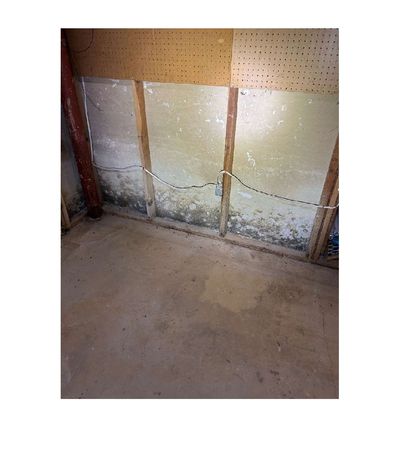
This is the classic basement mold pattern I see most often. The mold concentrates at the base of walls, where moisture accumulates against the concrete or block foundation. It grows along the lowest foot or two of the wall and often spreads behind basement finishes (drywall, pegboard, paneling) where it stays hidden until the finish is removed. Cladosporium and Penicillium, the two most common basement mold genera in our region, can begin colonizing a damp surface within 24–48 hours of a moisture event, which is why a single slow leak can establish widespread growth before anyone notices.
In this photo from a recent Bucks County inspection, the mold is dark brown and clearly visible once the pegboard came off. The homeowner had no idea it was there. The basement looked dry on the surface. There was no obvious water pooling. But the slow, persistent moisture migrating through the foundation created the perfect environment for mold.
This pattern typically means one of two things: either water is seeping directly through the foundation wall, or humidity is promoting condensation on the cool concrete surface. Either way, the basement has a moisture problem that won't resolve on its own. Basement relative humidity above 60% sustains active mold growth year-round, and Philadelphia's humid summers push plenty of basements well past that threshold without a dehumidifier running.
Where does mold grow behind basement walls and near plumbing?
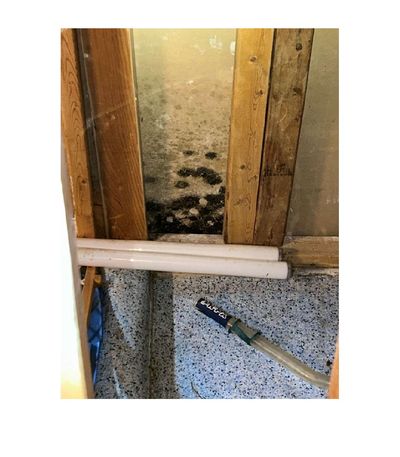
Plumbing creates a special environment for mold in basements. Cold water lines sweat during humid summer months, and that condensation drips down the wall and across flooring. Drain lines can leak invisibly, adding moisture to wall cavities. The result is concentrated mold growth around the plumbing runs.
In this photo, the mold is directly adjacent to a bank of water supply lines. The pipes are cold, the basement humidity is high, and condensation is running down the wall consistently during the cooling season. The mold has grown along that wet path for what appears to be at least one full year.
The danger here is that this mold is often hidden until you look behind or around the piping. A buyer touring the basement might not notice anything wrong. But a thorough inspection, especially air quality testing, will reveal the problem.
What does block wall discoloration and efflorescence tell you about basement mold?
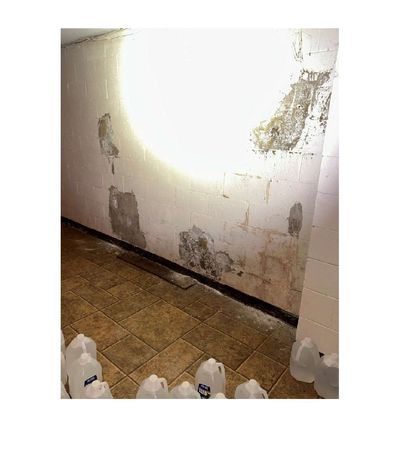
Concrete and concrete block are notorious in Philadelphia-area basements. The material is porous, and our clay-heavy regional soils mean water is almost always pushing against the foundation. You'll often see two distinct signs on block walls: dark discoloration (mold) and light-colored mineral deposits (efflorescence).
Efflorescence is the water-soluble salts from the concrete and soil migrating outward as water moves through the wall. It's not mold, but it's a definitive sign of moisture. Where you see efflorescence and dark discoloration together, you almost always have active mold growth as well.
In this Chester County inspection, the block wall shows multiple areas of discoloration. Some are old stains from past moisture events. Some are active mold. Without testing, it's impossible to know which is which, which is why visual inspection alone often misses the full picture.
How does mold grow behind framing and insulation in finished basements?
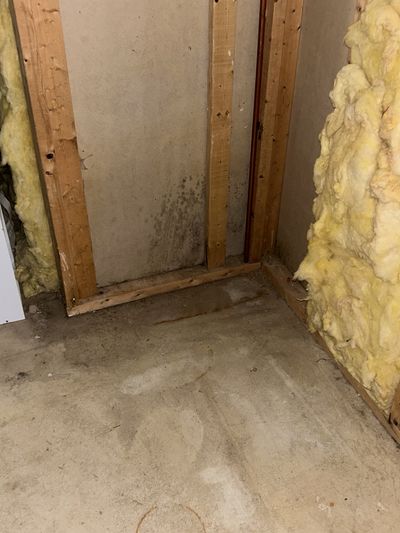
The rim band, the area where the rim joist, band board, and insulation meet the foundation wall, is mold central in Philadelphia-area basements. Cold concrete. Moisture-trapping insulation. Poorly sealed rim spaces. It's the perfect storm for mold. Stachybotrys chartarum, the black mold you've heard about, requires continuous moisture for 8–12 days before becoming visible, but other common species can take hold in the rim band much faster and spread quietly for months before anyone opens the wall.
When basements are finished with drywall and framing, this entire zone becomes invisible. A finished basement can hide serious mold growth in the rim band and behind the new walls. The homeowner has no way of knowing unless they remove the drywall, or unless someone does a thorough inspection before finishing.
In this photo, you can see dark brown mold across the framing members and insulation. This was found during a pre-purchase inspection in a Delaware County home. The buyer had planned to finish the basement, but now understood they'd need to address the moisture and mold first, which significantly changed the scope and cost of the project.
Why can you see mold in a basement but still get "not elevated" air test results?
This is the question that confuses homeowners most. A home inspector finds visible mold, takes photos, and recommends testing. The PRO-LAB air quality test comes back "normal" or "not elevated," and the homeowner is baffled.
Visible mold and air quality results are measuring different things.
Visible mold tells you there is active moisture and microbial growth in a specific location. It's real, it's there, and it matters. But it might be in a contained area: behind a wall, in a basement corner, in a crawlspace. The spores from that localized growth might not be circulating throughout the home's air in high enough concentrations to show as "elevated" in whole-home air sampling.
Conversely, you can have elevated mold spore levels throughout a home with no visible growth anywhere, because the mold is hidden in HVAC ductwork, beneath flooring, or inside wall cavities.
I once inspected a home in Northbrook where the homeowner was adamant that their basement was dry and mold-free. Visual inspection showed clear evidence of mold along the rim band and block walls. Air quality testing, sent to a certified lab, showed spore counts in the normal range. The visible mold was real. The air results were accurate. What that told us: the mold was localized, not circulation through the home's air in high concentrations, but it was still a moisture problem that needed addressing.
This is why I recommend both visual inspection and air testing when there's any concern. They tell different stories, and both matter.
What should you do if you see mold signs in your basement?
If you're seeing dark staining, discoloration, or visible fuzzy growth in your basement, follow this action plan:
First: Document it. Take photos. Note the locations. Watch for patterns: do the stains appear after rain? After humid summer weeks? Are they spreading?
Second: Call for professional testing. Don't wait. PRO-LAB air sampling for a basement starts at $290 and returns results in 2–3 business days, and those results give you objective data on spore types and concentrations, not just a yes/no answer. You'll know whether spore levels are elevated and what action is warranted. If you're buying a home, this test is a non-negotiable part of due diligence.
Third: Address the moisture, not just the mold. Painting over mold, applying mold-killing spray, or covering it with drywall doesn't solve the problem. The moisture is still there, and mold will return, often faster and more aggressively. A certified mold remediation firm can address active growth following EPA remediation guidelines. The 3x3 rule is standard: any mold area larger than 3 feet by 3 feet requires professional remediation rather than DIY cleanup. Most basement mold remediation projects in our area cost $1,000–$3,500 depending on the square footage affected. Plan for more if moisture has reached framing or insulation behind finished walls.
Fourth: Fix the source. If water is seeping through the foundation, you need a solution: either interior or exterior drainage, foundation sealing, or sump pump installation. If condensation is the driver, dehumidification and improved ventilation are the fix. The mold itself is a symptom. The moisture is the disease.
What is the most important thing to know about basement mold in the Philadelphia area?
Basement mold in the Philadelphia suburbs is common, it's detectable, and it's fixable, but only if you know what to look for and take it seriously. The homeowners I speak with after they've found mold almost always say the same thing: "I had no idea this was there."
That's the point of showing you these photos. Mold doesn't always announce itself with obvious growth or strong smells. It hides behind walls, along foundation lines, in rim band insulation, and in other invisible locations. A thorough visual inspection combined with air quality testing catches what eyes alone will miss.
If you're buying a home in Philadelphia, the river towns like Conshohocken, or out toward Norristown, or if you're concerned about moisture and mold in your current basement, call me. I personally oversee every mold-related inspection and testing we do, and I can tell you exactly what you're dealing with, and what needs to happen next.
At a starting price of $290 for an air test with 2 to 3 day lab turnaround, confirming basement mold costs far less than a single day of remediation labor.
Need Professional Mold Testing?
All Seasons provides PRO-LAB certified mold testing and air quality analysis across the Philadelphia region and South Jersey. Owner-operator Bob personally collects all samples. Results in 2-3 days. Call 610-348-6728 for a free estimate.
All Seasons typically schedules mold testing appointments within the week throughout the 5-county Philadelphia region.
Basement Mold Testing by Area:
Philadelphia Norristown Cheltenham Upper Darby Ardmore Abington Conshohocken