In June 2026, mold testing was requested at a Germantown, Philadelphia property after a prior home inspection had flagged suspect mold on the ceiling in the back of the basement. The buyer requested a swab before closing. The results confirmed what the inspector had suspected: Stachybotrys chartarum, the mold species commonly known as black mold.
This case is a good example of the right sequence: a professional home inspection raises a flag, mold testing confirms the specific finding, and the buyer has objective lab data before the transaction closes rather than after.
What the Prior Inspection Found
The home inspection had identified suspect mold on the basement ceiling, specifically in the back section of the basement where insulation was visible overhead. The inspector noted the area as warranting further testing but could not identify the species by visual inspection alone. That is the correct and honest approach: a home inspector is not a mold testing laboratory.
The request was specific: take a swab of the suspect area on the basement ceiling and send it to PRO-LAB for species identification.
What the Photos Showed Before Testing
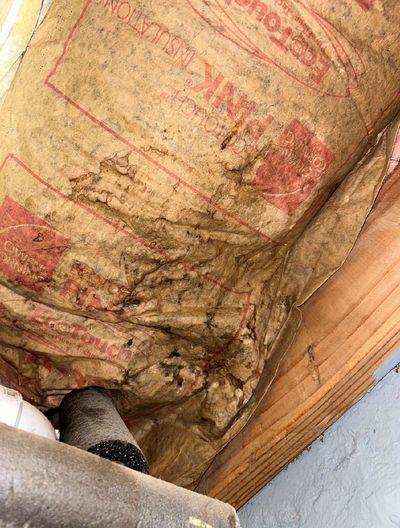
Looking up at the basement ceiling, the insulation showed heavy discoloration: dark biological growth on the surface of the insulation batt, consistent with mold. The area around an overhead pipe was particularly affected. In older Germantown homes with below-grade basements and limited ventilation, this type of ceiling insulation mold is a known pattern.
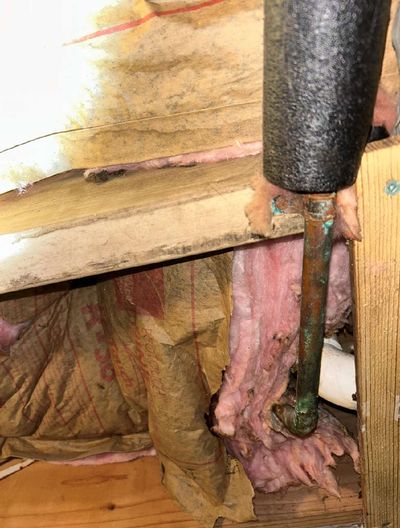
A second angle revealed the source: a copper pipe above the insulation showed green oxidation, the characteristic color of corroded copper indicating a slow, chronic drip. The insulation was pulled away from the joists and saturated from sustained moisture. This is not a recent water event. This is a leak that has been feeding the enclosed space for long enough for Stachybotrys to colonize.
What PRO-LAB Testing Confirmed
The swab sample came back from PRO-LAB confirming Stachybotrys chartarum. Not a generic mold positive. The specific species that requires chronic sustained moisture, produces mycotoxins, and the EPA recommends against disturbing without proper containment and respiratory protection.
The lab result is what converts a visual observation, "that looks like mold," into an actionable finding with a defined remediation path.
Why Germantown Basements Are Particularly Vulnerable
The Germantown neighborhood of Philadelphia has a housing stock that is predominantly pre-1960, with many homes dating to the early 20th century or earlier. These homes have:
- Older plumbing systems: copper and galvanized pipes that have decades of slow-corrosion exposure, making slow drips common and often invisible inside insulated ceiling cavities
- Unfinished or partially finished basements: spaces with limited airflow and below-grade conditions that concentrate humidity
- Limited mechanical ventilation: older homes rarely have basement exhaust fans or dehumidification systems built into the original construction
- Dense urban siting: row homes and semi-detached homes with limited solar exposure on north or interior-facing walls concentrate ground moisture
The combination of an aging plumbing system and a poorly ventilated basement is exactly the environment Stachybotrys looks for. The mold does not need a flood. It needs a slow drip and a contained space.
What Stachybotrys Means and Why It Requires Professional Remediation
Stachybotrys chartarum is the species most commonly referred to as black mold. Unlike many common indoor molds, Stachybotrys is a significant health hazard because it produces trichothecene mycotoxins. These compounds are associated with respiratory irritation, neurological effects, and immune responses, particularly in sensitive individuals including children, the elderly, and anyone with compromised respiratory health.
The EPA recommends professional remediation for any mold-affected area exceeding 10 square feet. Stachybotrys specifically should not be disturbed without proper containment and HEPA filtration, because disturbing a colony releases spores and mycotoxins directly into the breathing zone. Household products like bleach are not effective on porous materials. They remove the visible color while leaving the root structures in place.
After professional remediation, post-clearance air sampling verifies that spore concentrations have returned to normal. Clearance sampling is the only independent confirmation that the remediation was successful, not just the contractor saying so.
The Takeaway for Philadelphia Home Buyers
If a home inspector flags a basement area as suspect mold, the appropriate response is to get it tested before closing, not to accept a seller's reassurance that it is "just water staining" or "old discoloration." In Germantown and across older Philadelphia neighborhoods, aging plumbing and below-grade basements create exactly the conditions where Stachybotrys can establish silently over years.
A swab test costs a fraction of what remediation costs. Finding out what you are buying before closing is always the better position.
Bob Klebanoff
Owner, All Seasons Home Inspections
610-348-6728 | Free Estimate
Mold Testing in Philadelphia and Surrounding Areas:
Germantown Cheltenham Elkins Park Abington Jenkintown Wyncote Glenside