In 20+ years of performing PRO-LAB certified mold testing in the Philadelphia region, I've found mold in hundreds of kitchens and laundry rooms. Most of the time, the homeowners had no idea it was there. The mold wasn't growing on surfaces they could see. It was thriving in the darkness behind walls, under flooring, and inside wall cavities where moisture collects and lingers.
Below is what I've photographed on actual inspections, why these spaces are mold magnets, and how to spot the warning signs before the problem becomes expensive.
Why are kitchens and laundry rooms such common places for hidden mold?
These two rooms share one critical characteristic: constant water use combined with limited air circulation and poor drainage design. Kitchens have dishwashers, ice maker lines, and sink plumbing. Laundry rooms have washing machines, water heater supply lines, and condensation from dryer vents.
When water systems leak even slightly, whether a few drops per day from a loose connection, a pinhole in a supply line, or a degraded hose, that moisture gets trapped in spaces that don't dry out naturally. Inside walls, under subfloors, and behind cabinets, there's no air movement. The moisture sits, the relative humidity stays above 70 percent, and within days to weeks, mold colonizes whatever organic material is present: drywall paper, wood framing, and insulation. Relative humidity above 60% creates favorable conditions for mold growth, and enclosed kitchen and laundry cavities routinely hit 80–90% when a slow leak is present. Mold can begin colonizing a wet surface in as little as 24–48 hours under the right temperature and humidity conditions.
Most homeowners discover the problem only when they renovate, experience an unpleasant smell, or I uncover it during a detailed inspection. By that point, mold has often been growing for months or even years.
What causes water to collect under kitchen floors, and how does it lead to mold?
This is the most common scenario I document. Slow leaks from dishwashers, ice maker supply lines, or under-sink shut-off valves drip onto the subfloor beneath kitchen flooring.
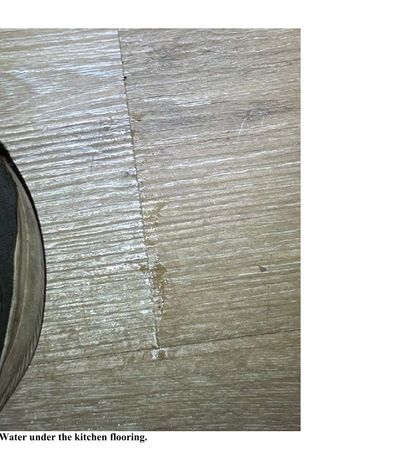
The homeowner sees nothing. The countertops are dry. The sink works fine. But beneath the vinyl or laminate flooring, the subfloor is wet. Plywood or particle board soaks up moisture and becomes soft, warping slightly. The wood fibers and the paper backing of any insulation beneath the floor provide perfect food sources for mold.
I've photographed subflooring where mold colonies had grown so extensively they blackened the entire undersurface.
The culprit is usually one of three things: a cracked ice maker line (supply hoses fail over time), a leaking dishwasher door seal, or a corroded shut-off valve that weeps continuously. These leaks are often so slow they barely dampen the surface, but on a daily basis, they're enough to keep the area perpetually moist. According to the EPA, the average household's leaks can waste about 9,400 gallons of water a year. Over 40% of Philadelphia-area homes were built before 1960, when kitchen ventilation standards were minimal and many sink cabinets were not designed with moisture management in mind. I see this constantly in the older housing stock of Norristown, where decades-old plumbing runs under original cabinetry.
Why does mold grow behind washing machines and laundry drain connections?
The space immediately behind a washing machine is another high-risk zone, and one where homeowners almost never look. Supply hoses run under constant pressure, and as the rubber ages it develops tiny cracks that leak water into the wall cavity behind the machine, wetting drywall and framing over time. The drain box connection adds to the risk: the plastic fittings where the drain hose meets the standpipe or house drain collect water and lint, creating a damp, humid microclimate where mold thrives even without a leak.
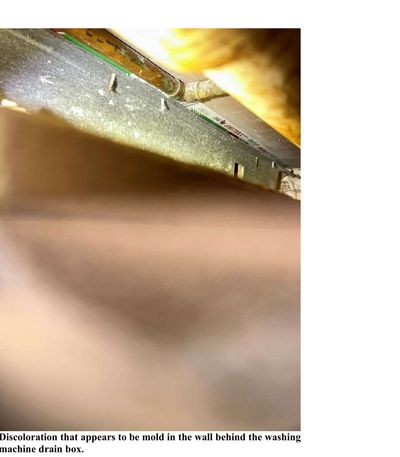
Clothes washer condensation, warm, humid air expelled from the drum, can also accumulate in an unvented or poorly vented laundry room, keeping the area behind the machine damp even without an active leak.
In many laundry rooms I examine in the Philadelphia area, from Cheltenham rowhomes to twins in Upper Darby, there is visible mold growth behind the washing machine. The mold ranges from light surface discoloration to heavy black or dark green colonies covering the lower wall. Rubber supply hoses degrade with age, yet many homeowners never replace them. A standard braided stainless hose costs under $20 at any hardware store and takes about 15 minutes to swap out; the cost of mold remediation behind a failed hose can run $1,500–$4,000 or more depending on how far the water spread.
How does mold get behind closet walls and shared plumbing walls?
Many homes have laundry alcoves or closets adjacent to kitchens or share walls with bathroom plumbing. These shared walls are packed with water supply lines, drain pipes, and in older homes, potentially deteriorating cast iron drainpipe.
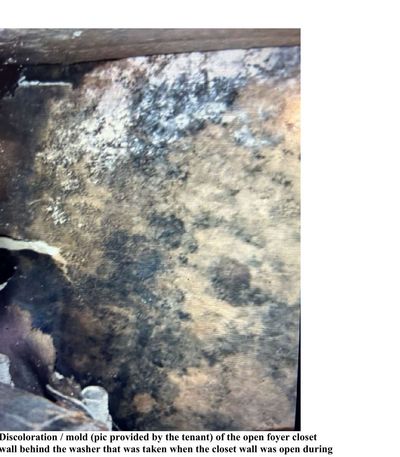
When there's a slow leak in one of those lines, especially a drain pipe leak, which homeowners often don't notice because the water is hidden, moisture saturates the wall cavity on the opposite side of the drywall from where people spend time. The wood framing absorbs moisture. Fiberglass insulation (if present) becomes damp. Drywall paper, which is cellulose-based, becomes food for mold.
I've encountered homes where the entire back side of laundry closet walls was colonized by mold because a corroded section of supply line inside the wall had been slowly weeping for years.
Why do kitchen cabinet bases develop mold?
Under-sink cabinetry is a moisture trap by design. The sink drains through that space. Supply lines run through it. When any of those connections leak, or when water splashes onto the cabinet base during cleaning and isn't cleaned up quickly, moisture accumulates in an enclosed, poorly ventilated space.
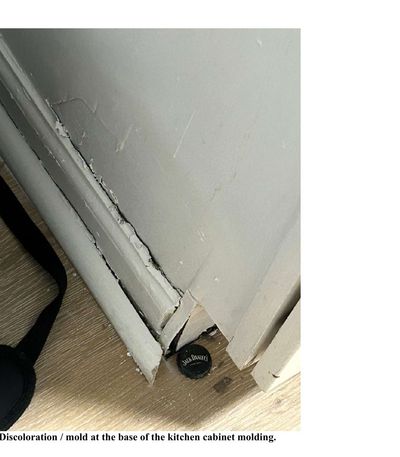
Cabinet bases are particleboard or plywood, materials that absorb water readily. When moisture sits against these materials for weeks or months, mold begins growing within the cabinet and on the flooring underneath. I've photographed kitchen cabinets where the bottom foot of interior walls was completely blackened by mold growth, yet the homeowner thought the cabinet just had dark staining from spills. Replacing water-damaged kitchen cabinetry typically costs $2,000–$6,000 before mold remediation costs are factored in, making early detection one of the most cost-effective steps a homeowner can take.
Contributing factors include: dishwasher door seals that no longer prevent water from escaping during the wash cycle, poorly sealed cabinet bottoms, and flooring that slopes toward the cabinet rather than away from it.
What does it mean when lab results confirm hyphae in mold samples?
I collected surface swab samples from several of the mold colonies shown in the photos above and sent them to PRO-LAB for identification. Lab results typically come back within 2-3 business days. The results came back with three key findings: Cladosporium, Penicillium/Aspergillus, and notably, the presence of hyphae.
Hyphae is the technical term for the microscopic thread-like filaments that make up mold structure. When a lab identifies hyphae in a sample, it means the mold isn't just spores in the air: it's an active fungal colony that has established and is growing. Spores alone are passive particles. Hyphae indicates active colonization and ongoing growth.
In plain English: the mold wasn't dormant. It was thriving at the time of sampling.
Cladosporium is common in soil and outdoors, but when found at elevated levels indoors on a surface sample, it indicates a moisture problem promoting mold growth in that specific location. Penicillium and Aspergillus are ubiquitous spore producers that thrive in damp environments inside homes.
The combination of these mold types plus active hyphae told me what I already suspected from the visual inspection: these were established, actively growing colonies driven by persistent moisture, not just cosmetic surface mold.
How can homeowners check their own kitchen and laundry room for mold risk?
You don't need professional equipment to spot risk factors. Here's a checklist I recommend every homeowner use:
Kitchen Mold Risk Checklist
- Look under the sink: Is the cabinet interior dry, or do you see dark staining, soft spots, or a musty smell?
- Check supply lines: Look at the shut-off valves and dishwasher supply connection for water stains on the wall or floor.
- Feel the flooring: Press on the floor tile or vinyl near the sink and dishwasher. Does it feel spongy or give slightly under pressure?
- Smell the sink cabinet: A persistent musty odor indicates mold growth, even if you can't see it.
- Inspect the ice maker line: If you have a refrigerator with an ice maker, look at where the supply line enters the wall. Are there water stains on the wall?
- Check cabinet bottoms: If you can see under kitchen cabinets, look for dark discoloration or soft spots in the particleboard or floor.
Laundry Room Mold Risk Checklist
- Move the washing machine: Look at the wall and floor behind it. Are there water stains, dark growth, or a damp smell?
- Inspect supply hoses: Check rubber hoses for cracks, bulges, or signs of age. Hoses typically last 5-7 years before failure becomes likely.
- Check the drain connection: Look at where the drain hose connects to the standpipe. Is the area wet, moldy, or covered in lint?
- Feel the floor: Is the flooring soft, stained, or spongy near the washer or water heater?
- Smell the room: A musty smell in a laundry room indicates moisture accumulation and potential mold.
- Check the dryer vent: If it's not properly vented to the outside, humid air is being discharged into the laundry room, keeping it damp.
When should you call for professional mold testing in kitchens and laundry rooms?
Call a professional as soon as you find visible growth, a musty odor you cannot trace, unexplained water stains, or flooring that feels soft underfoot. Any past water damage that was never professionally remediated is also a trigger, as are allergy symptoms that reliably worsen in one specific room. If your checklist reveals any of the following, it's time to call:
- Visible mold growth on surfaces
- Musty or earthy odors you can't pinpoint
- Water stains on walls, cabinets, or flooring that you can't explain
- Soft or spongy flooring in kitchen or laundry areas
- A known history of water damage that wasn't professionally remediated
- Any unexplained allergy symptoms that worsen in specific rooms
- You're buying or selling a home and want verification
I personally perform PRO-LAB certified air quality testing, which means your samples go to an independent, accredited laboratory. The lab identifies the types of mold present, measures spore concentrations, and compares indoor levels to outdoor baseline. If elevated mold is detected, the report explains exactly what it means and what actions are recommended.
Lab results typically come back within 2-3 business days of sample collection. Costs start at $290 for air sampling plus lab analysis.
The most important thing I can tell you: mold is a symptom, not a disease. The disease is moisture. The EPA mold guidelines make the same point: controlling moisture is the only permanent solution. Finding the mold is step one. Finding and fixing the water source is the only permanent solution. Any remediation that doesn't address the moisture driving the growth is temporary.
Questions about mold or water damage in your kitchen or laundry room? Call me directly at 610-348-6728. I answer my own phone and I'm happy to walk you through what you're seeing.
With PRO-LAB air testing starting at $290, confirming a mold problem costs a fraction of what remediation typically runs.
Need Professional Mold Testing?
All Seasons provides PRO-LAB certified mold testing and air quality analysis across the Philadelphia region and South Jersey. Owner-operator Bob personally collects all samples. Results in 2-3 days. Call 610-348-6728 for a free estimate.
Mold Testing Serving These Areas:
Philadelphia Norristown Cheltenham Upper Darby Ardmore Abington Conshohocken