In September 2026, I tested a rowhome in Philadelphia's 19147 ZIP code. The owner had reported past water infiltration, and water stains had been noted in several areas of the property. Nothing about the request was unusual. Older Philadelphia rowhomes carry water history the way most old houses do, and a stain on its own does not tell you much.
What made this test worth writing up is what happened when I opened the wall void behind the HVAC closet. There was discoloration consistent with mold on the framing inside that void and on a joist above the HVAC unit. The air samples I took, one in the utility closet void and one on the second-floor landing, both came back Normal. Those two facts are not a contradiction. They are the whole reason a visual check of concealed spaces matters alongside air sampling, and why a Normal air result is not the same thing as a clean bill of health.
1. Water Stains That Pointed to a History Worth Checking
The owner told me about past water infiltration into the property, and I found water stains in more than one area during the walk-through. Staining like this can be old and settled, or it can be a sign of a moisture path that is still active. You cannot always tell which from the surface alone, especially when the stain is faint.
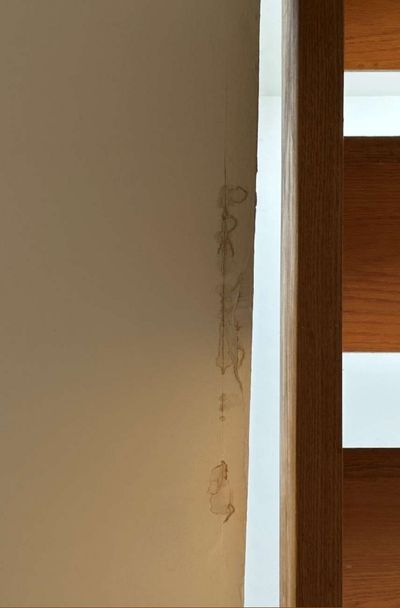
2. Opening the Wall Cavity Showed Water Damage Behind the Surface
Given the water history, I opened up a section of wall and floor cavity for a closer look. What was behind the surface was worse than the interior staining suggested: visible water damage to the framing and subfloor, with darkened, saturated wood in the cavity. This is the gap between what a wall looks like from the room and what is actually happening inside it.
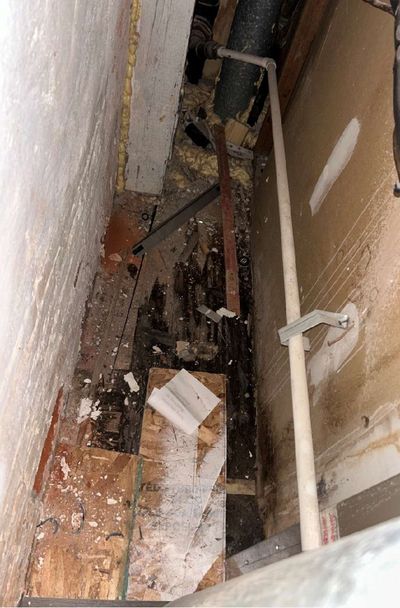
3. Mold on the Framing Inside the HVAC Closet Wall Void
The HVAC closet was the other area of concern. Behind the closet wall, in a narrow void next to the foundation, I found discoloration consistent with mold running along the framing. This is a space that is not part of anyone's daily view of the house. Nobody walks past it and notices anything, because nobody sees it at all unless the wall comes open.
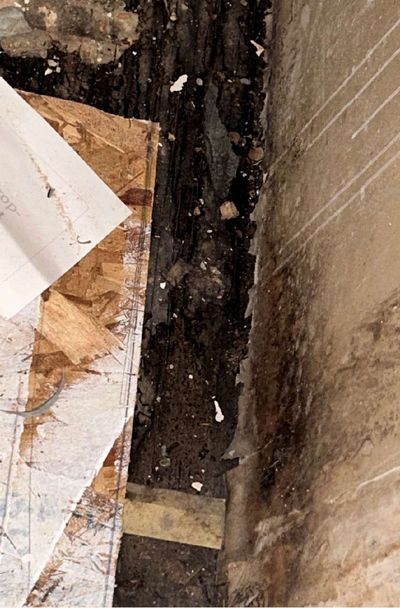
4. The Same Void, With Piping and Insulation Involved
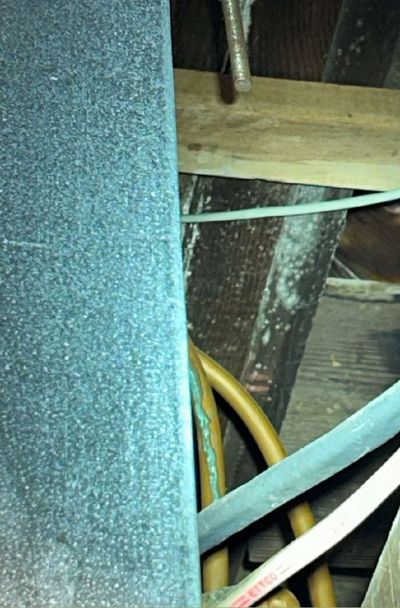
The void extends around the ductwork and plumbing serving the HVAC unit, and the moisture and staining were not limited to one isolated spot. Insulation and framing near the piping runs showed the same pattern of dampness and discoloration, which points to a moisture source that has been present for some time rather than a single isolated event.
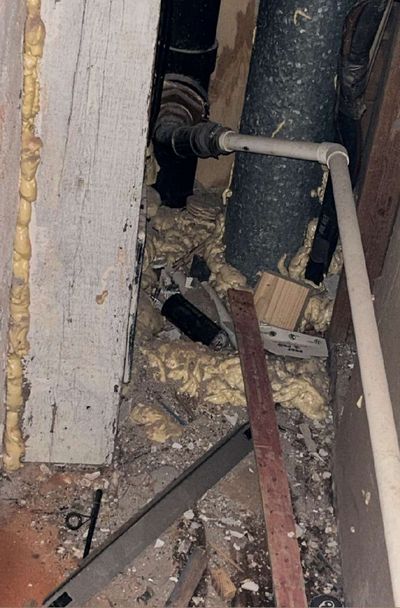
5. Mold on the Joist Above the HVAC Unit
Above the HVAC unit itself, the joist showed light-colored growth typical of surface mold on wood framing. Combined with what was found in the wall void a few feet away, this told a consistent story: moisture has been reaching this mechanical area for long enough that mold has established itself in more than one spot around it.
6. Where the Air Samples Were Taken, and What Came Back
Two air samples were taken on this job: one in the utility closet void itself and one on the second-floor landing, well away from the mechanical area. Both samples came back with a lab result of Normal Mold. That means the airborne spore counts in those two locations, at the time of sampling, did not read as elevated.
This is the part of the report that is easy to misread. A Normal air result sounds like good news across the board, and taken alone, it can lead a homeowner to assume the mold on the framing and joist is not a real concern. It is a real concern. The air sample tells you about the air in the room at that moment. It does not tell you what is or is not growing inside a semi-sealed wall void, especially one that is not actively venting into the space being sampled. That is exactly why I opened the wall and looked, rather than relying on the air result alone.
7. What a Normal Air Result Does Not Mean
A Normal result is a genuinely good outcome for the air quality in the space that was sampled, and I am not going to overstate what was found here into something it is not. This was not an emergency-level infestation, and the recommendation reflects that: have a qualified contractor further evaluate the affected areas, seal the water sources that are letting moisture into the wall void, and remove the mold that is already growing.
But Normal air and visible mold in a concealed cavity are not in conflict. They are two different measurements of two different things. If a homeowner only ever sees the lab sheet and never sees what a contractor finds behind the wall, "Normal" can read as a clean bill of health it was never meant to be. The honest summary of this job is: the air people breathe in this house tested Normal, and there is still an active moisture and mold problem inside a wall that needs to be sealed and remediated.
What This Test Means for Other Philadelphia Rowhome Owners
Rowhomes throughout Philadelphia share a set of conditions that make this exact scenario common: narrow mechanical closets built against party walls and foundations, ductwork and piping running through tight voids, and decades of small water events that leave stains without anyone ever opening the wall to check behind them. A Normal air sample in the room does not rule out a mold problem inside one of these voids, and that is the single most useful thing to take from this report.
If you own or are buying a rowhome in Philadelphia, Queen Village, or Fishtown and you have a history of water infiltration, visible water stains, or a mechanical closet that has never been opened up for a close look, that history is worth acting on rather than assuming it is old news. A mold test that includes both air sampling and a visual check of concealed spaces is how you find out what is actually happening, instead of guessing from a stain on the wall.
If you want a Philadelphia property tested, schedule a mold test with All Seasons. I personally perform every test and write every report.
Bob Klebanoff
Owner, All Seasons Home Inspections
610-348-6728 | Free Estimate
Mold Testing in Philadelphia and the Surrounding Neighborhoods:
Philadelphia Queen Village Bella Vista Graduate Hospital Fairmount Northern Liberties Fishtown