In December 2025, I was called out to a home on Northbrook Road in Kennett Square, Chester County. The owner had two things on their mind. There was visible mold discoloration on sections of the basement walls, and there were water stains spread across ceilings on both the first and second floors from past leaks. What they wanted to know was simple and reasonable: was any of this ending up in the air the household was breathing?
To answer that, I documented the visible conditions and took an air sample at the HVAC central return duct, along with an outdoor control sample the same day. The PRO-LAB results came back with an answer that surprises a lot of homeowners, and that is exactly why this job is worth walking through.
1. Visible Mold on the Basement Foundation Walls
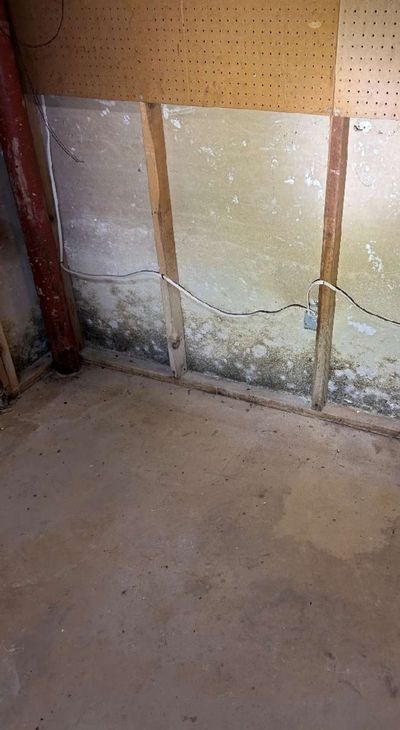
The basement was where the visible growth was. Along the base of the foundation walls, at the wall-to-floor junction and up between the wall framing, there was dark mold discoloration. In one stud bay the growth was heavy and black, spreading across the wall surface above a pipe run. This is the classic pattern: mold concentrates low on the wall where moisture collects and lingers.
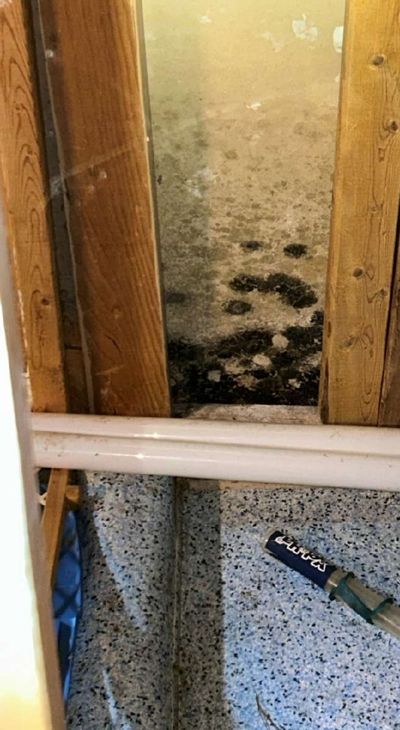
Visible growth this defined is not a maybe. It is a source. The question a mold test answers is not whether this needs attention, because it does, but whether that source is also loading up the air the family breathes upstairs.
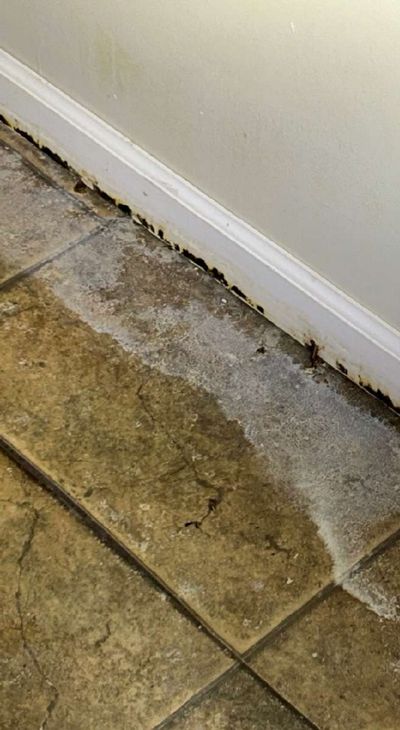
2. Water Staining and Efflorescence on the Basement Walls
Along with the growth, the basement showed the moisture history behind it. Sections of the painted block foundation wall carried dark water staining, and at the base of the walls there was efflorescence, the white chalky mineral deposit left behind when water pushes through masonry and evaporates on the inside surface. Efflorescence is not mold, but it is a reliable fingerprint of the exact moisture pathway mold needs.
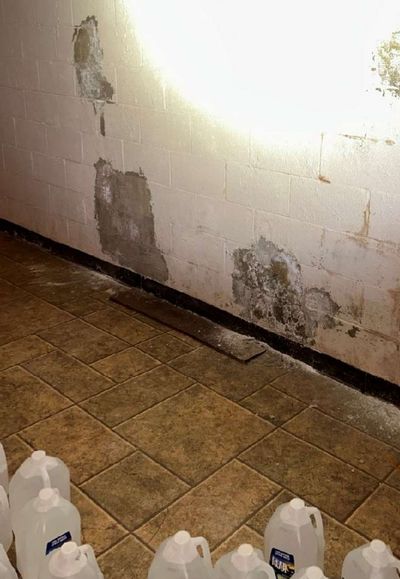
When you see efflorescence and staining together with actual growth in the same basement, you are not looking at a one-time spill. You are looking at a wall that has been getting wet, repeatedly, for a while. That matters for what happens after the air test, because the moisture is the thing that has to be fixed for any remediation to hold.
3. Evidence of Past Leaks on the First and Second Floor Ceilings
The moisture was not only in the basement. On both the first and second floors, ceilings carried the brown blistered stains and peeling paint of past water leaks from above. In one spot the ceiling material had failed and pulled away, exposing insulation near a duct. These are the marks of water that came through from the roof or plumbing above, at some point in the past.
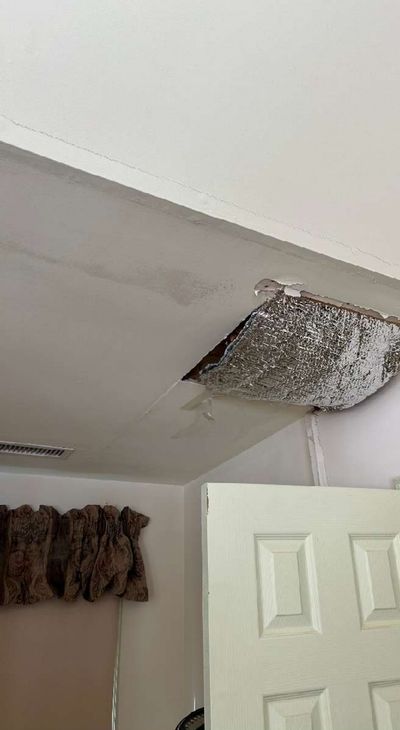
Ceiling stains like these are worth documenting even when they look old and dry, because the cavity above a stained ceiling is exactly the kind of hidden space where mold can grow out of sight. A stain is the visible edge of a wet event you cannot see the full extent of from below.
4. Why We Sampled the HVAC Central Return Air
With visible growth in the basement and stained ceilings on two floors, the owner's real worry was the air. So the air sample went where it would tell us the most: the HVAC central return duct. That is the point where the air handler draws air out of the living space before conditioning it and sending it back out through the registers. Sampling there captures a representative mix of the air actually circulating through the home, and if a hidden source were feeding the distribution system, the return is one of the better places to catch it.
An outdoor control sample was taken the same day, from fresh air away from the house. That control is not optional. An indoor spore count means nothing by itself. It only means something compared to what is drifting through the outdoor air on that same day.
5. What the Lab Found, and Why It Did Not Close the Case
The PRO-LAB results were clear. The HVAC return air sample came back not elevated. The indoor total was 107 spores per cubic meter, made up of Penicillium/Aspergillus at 80 and a small amount of ascospores at 27. The outdoor control totaled 290 spores per cubic meter, with Penicillium/Aspergillus at 130 plus Cladosporium, ascospores, and basidiospores. In other words, the air inside the home carried fewer spores than the air outside it that day. There was no elevated airborne mold signature.
Here is the part homeowners find counterintuitive. A not elevated air result did not mean there was no mold problem. It meant that at the moment of testing, the visible basement growth was not measurably loading the circulating air. The growth on the walls was still there. The moisture feeding it was still there. A source that is quiet in the air today can change the moment it is disturbed, or once the next wet season raises the moisture again. That is why the recommendation did not stop at the air number. I advised having a qualified mold remediator evaluate and remove the discoloration, following the EPA guidance that any area of growth roughly three feet by three feet or larger be properly remediated, and to fix the moisture: control humidity, run a dehumidifier in the warm months, keep gutters and downspouts clean and aligned, maintain positive grade around the foundation, add drainage if needed, keep the HVAC filter and ducts clean, and repair any plumbing or water intrusion within twenty four hours.
What Kennett Square Homeowners Should Know About Mold Testing
This job is a good illustration of what mold testing does and does not do. Testing identifies and quantifies what is in the air, and it compares it honestly against an outdoor baseline. It gave this family a real, reassuring answer about the air they were breathing. What testing does not do is remove mold or fix the moisture that caused it. Those are separate steps, and a clean air reading does not skip them when there is visible growth on the wall.
If you own a home in Kennett Square with a basement that shows staining, efflorescence, or visible growth, or ceilings marked by past leaks, the smart move is to get it tested and documented, then address the source. Testing tells you where you stand. It does not replace remediation when there is a source to remove. Across West Chester, Downingtown, and the greater Chester County area, older homes with below-grade moisture are common enough that knowing for sure beats assuming either way.
If you are buying, selling, or living in a home in Kennett Square or the surrounding communities and you want the air tested and the conditions documented properly, schedule a mold test with All Seasons. I personally perform every test, take the outdoor control the same day, and hand over the full lab report, not just a summary line.
Bob Klebanoff
Owner, All Seasons Home Inspections
610-348-6728 | Free Estimate
Mold Testing in Kennett Square and the Surrounding Area:
West Chester Downingtown Exton Malvern Paoli