In May 2026, I inspected a 75-year-old row house in Northeast Philadelphia (zip code 19149) for a buyer. The home had been maintained and was rated Good overall. The seller had clearly cared for it. No serious deferred maintenance was apparent on the surface.
Good overall condition on a 75-year-old home means the owner did their job. It does not mean there are no findings. What it means is that the findings you do find are age-related rather than neglect-related, and age-related findings on a well-built mid-century row home are often repairable rather than replaceable. This inspection turned up seven findings, covered one at a time below.
1. Strong Gas Odor in the Basement Bathroom
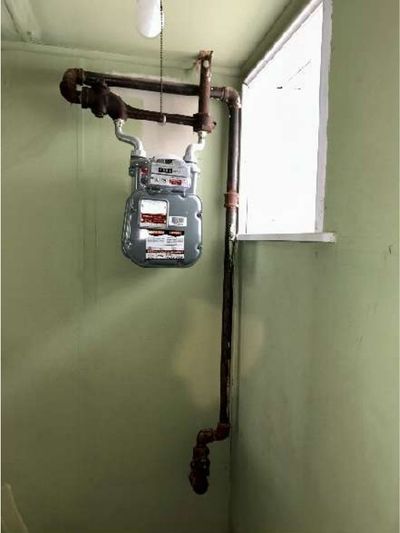
The first thing I noted upon entering the basement bathroom was a strong gas odor. Not a faint background smell, but a persistent, noticeable odor in a partially enclosed space with limited ventilation.
A confirmed gas odor in an enclosed space is treated as an immediate life-safety finding. The sequence is: document it in the report, notify the buyer immediately, and ensure the gas utility is contacted before occupancy. Philadelphia Gas Works should be notified for leak assessment and service shutoff to the affected line if needed. This is not a repair credit item. It is not a price negotiation point. It is a condition that must be resolved before anyone enters the home as a resident.
In this case, the finding was escalated at the time of inspection, the utility was notified, and the issue was confirmed and resolved before closing. That is the correct outcome, and it would not have happened without someone in that basement bathroom with their nose and their report pad.
2. Frayed Service Entrance Cable at the Weatherhead
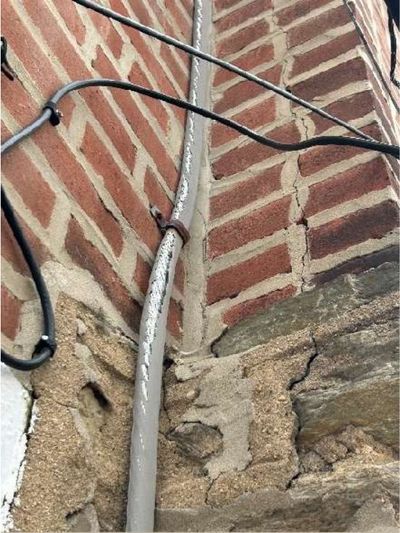
The service entrance cable (the conductor that runs from the utility weatherhead at the top of the house down to the electric meter) showed fraying on its outer insulation jacket. Seventy-five years of UV exposure, freeze-thaw cycling, and weather have taken the expected toll on the cable's outer protection.
A frayed service entrance cable has compromised insulation on a conductor that carries the home's full electrical load. This is a licensed electrician and utility coordination job. The cable connects to utility equipment and cannot be replaced unilaterally. The cost of replacement is typically modest; the risk of leaving it as-is is not. This was flagged as a priority electrical finding.
3. Missing Slate Tiles and Corroded Valley Flashing
The slate roof on this home, original to the structure and approximately 75 years old, had several missing individual tiles where original nails had rusted through and slates had shifted or fallen. Missing tiles are expected on a slate roof of this age and are routinely repaired by a licensed slate roofing contractor.
The more significant finding was the corroded valley flashing. Valley flashing is the metal strip that covers the junction between two roof planes, the lowest point of the roof, where water from both sides concentrates. On this home, the valley flashing had oxidized to the point where its waterproofing integrity was compromised. In 20+ years of inspections, valley flashing failure is the source of more active roof leaks on Philadelphia-area slate roofs than any other single factor. The slate tiles were largely sound; the flashing was not.
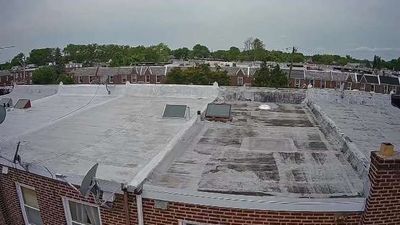
The repair plan here is targeted: replace the corroded valley flashing, reinstall the missing tiles, and evaluate the overall deck condition for any areas of sheathing damage from prior leaks. A full roof replacement is not indicated by the tile condition alone, but the flashing is not optional.
4. Asbestos 9-Inch Floor Tiles
Nine-inch square vinyl floor tiles are one of the clearest age markers in mid-century row homes. Tiles of this dimension installed before 1978 almost universally contain asbestos. It was a standard additive to vinyl floor tile in this era for durability and fire resistance. The tiles in this home were identified in basement utility areas.
Intact 9-inch tiles in stable condition are typically left in place. Asbestos that is undisturbed and in good condition is not considered an immediate health hazard. The risk changes when the tiles are disturbed by sanding, grinding, breaking up, or removal without proper containment. If any flooring renovation is planned in areas with 9-inch tiles, an asbestos abatement contractor needs to be part of the project plan before the floors come up.
5. Wet Basement Wall with Possible Mold Discoloration
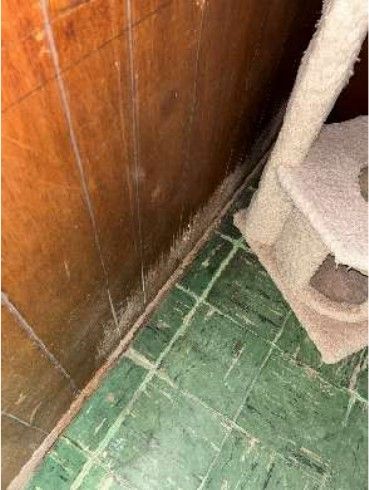
One basement wall showed active moisture, with a discoloration pattern at the wet area consistent with possible mold growth. On a 75-year-old concrete block foundation with no waterproofing membrane, basement moisture is common, but possible mold discoloration adjacent to a wet wall warrants more than a visual assessment.
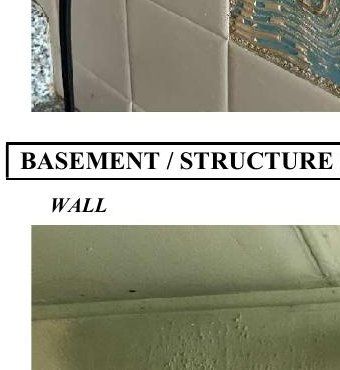
Air sampling was recommended before closing to identify whether airborne mold concentrations in the basement were elevated, and if so, which mold types. "Possible mold" on a visual inspection is a reason to test, not a reason to assume either that it's fine or that it's a crisis.
6. Corroded Cast-Iron Waste Stack
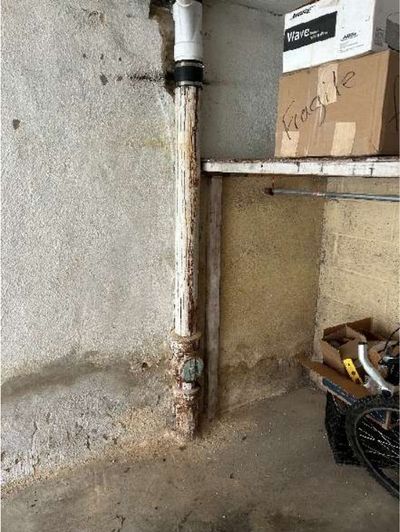
The cast-iron waste and vent stack, original to the home, showed corrosion scale and the beginning of pinhole formation at several accessible points. Cast-iron drain piping begins developing pinholes at roughly 60–80 years of age; on a 75-year-old home, this finding is neither surprising nor deferrable indefinitely.
Early pinholes in cast iron are often manageable with targeted section replacement rather than full stack replacement. The report documented every accessible section of stack and noted where corrosion was most advanced, giving the buyer a clear picture of what plumbing budget to anticipate over the next 5–10 years.
7. Blown Thermal Pane Windows
Several windows throughout the home showed the characteristic fogged appearance of failed thermal pane seals. The argon gas fill between the panes has leaked and allowed condensation to form between the glass layers. Fogged thermal panes reduce the insulating value of the window but are not a structural or safety issue. This is a budget item, not a critical finding, and was noted accordingly.
What Buyers Should Expect From Row Home Inspections in Northeast Philadelphia
This inspection found a gas odor, a frayed service entrance cable, corroded valley flashing, asbestos tiles, basement moisture, a corroding waste stack, and seal-failed windows, on a home that its owner maintained in Good condition. That is not unusual for a 75-year-old row home. What would be unusual is a 75-year-old row home with none of those findings.
The value of the inspection is not finding a home with no findings. It is finding a home where all the findings are documented, priced, and accounted for, so that what you're buying is exactly what you think you're buying, at a price that reflects what it will cost to own it properly. Every finding in this report was findable by an inspector who spent the time to look. None of them would have appeared on a 90-minute walk-through.
The same mid-century housing patterns show up across this part of the region. I see them regularly in the row homes and twins of Germantown and in the older neighborhoods of Cheltenham just over the city line.
If you're buying a row home in Northeast Philadelphia, in the 19149, 19111, 19115, or surrounding zip codes, schedule an inspection with All Seasons. I personally perform every inspection, and I'm familiar with exactly what these homes bring.
Bob Klebanoff
Owner, All Seasons Home Inspections
610-348-6728 | Free Estimate
Home Inspections in Northeast Philadelphia and the Surrounding Area:
Northeast Philadelphia Philadelphia Germantown Abington Cheltenham Norristown