In September 2025, I performed a mold test on a home on Wagner Road in Lafayette Hill, in Whitemarsh Township, Montgomery County. The customer requested a specific scope: air grabs in the HVAC central return duct and the master bedroom, plus a surface swab of some discoloration that had been noticed on the back attic roof sheathing, in the section of attic above the master bedroom.
What came back from the lab is a good teaching case, because the two kinds of samples did not agree. The air was clean. The surface was not. Here is what that means and why it matters if you are trying to figure out whether you have a mold problem.
1. The Air Samples Came Back Normal
The two air grabs, one in the HVAC central return and one in the master bedroom, were not elevated. In plain terms, the concentration of airborne mold spores in the breathing air of the occupied space was within a normal range at the date and time of the test.
That is genuinely good news, and it is the part a lot of people would want to hear and stop at. If all we had taken were air samples, the honest summary would have been that the indoor air did not show elevated mold. But the homeowner had noticed visible discoloration up in the attic, and a normal air sample does not explain a stained roof deck. That is why the swab was part of the scope.
2. The Attic Swab Confirmed Unusual Mold on the Sheathing
The swab was taken from the discolored area on the back attic roof sheathing, above the master bedroom. The lab result on that swab indicated unusual mold present on the surface. So the same property, tested the same day, produced a normal air result and a positive surface result at the same time.
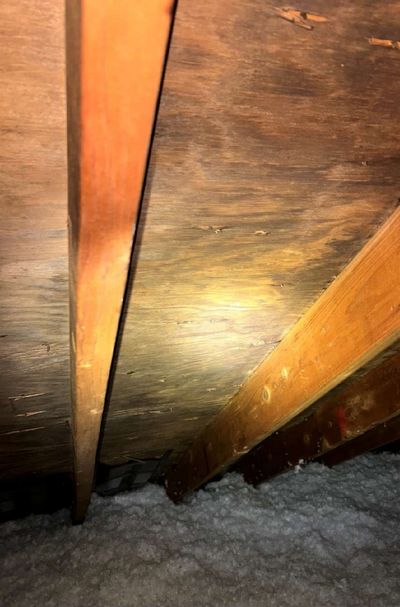
This is not a contradiction, it is the whole point. An air sample tells you what is floating in the air right where you take it. A surface swab tells you what is actually growing on a specific spot. Attic space is separated from the living area below, so growth on the roof sheathing does not necessarily push spores down into a bedroom in numbers high enough to move an air reading. Testing the visible discoloration directly is the only way to know what it is.
3. Why Attic Sheathing Grows Mold in the First Place
Mold on attic roof sheathing is usually a moisture and ventilation story rather than a roof leak. In a home like this one, warm humid air from daily living rises into the attic. In cold weather that moist air hits the cold underside of the roof deck and condenses. If the attic is not ventilated in a balanced way, with intake low at the soffits and exhaust high at the ridge, the sheathing stays damp long enough for mold to take hold. The dark staining you see between the rafters is the record of that cycle repeating over many winters.
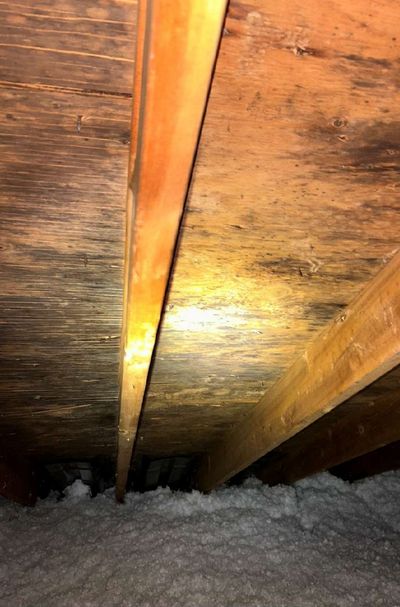
The distinction matters because it changes the fix. If you clean the discoloration but leave the attic under-ventilated and the moisture source in place, the mold comes back. Homes across Plymouth Meeting, Conshohocken, and the older parts of Whitemarsh Township have exactly this kind of attic, where original ventilation was never generous and decades of insulation upgrades sometimes made it worse by blocking the soffit vents.
4. What the Report Recommended
The recommendation was to have a qualified contractor remediate the mold to reduce the risk of a health hazard. Alongside the remediation itself, the report laid out the moisture-control steps that keep it from returning: increase humidity control and HEPA filtration in the rooms that are occupied most, keep the HVAC air filter and ducts clean, and dehumidify during the warm months.
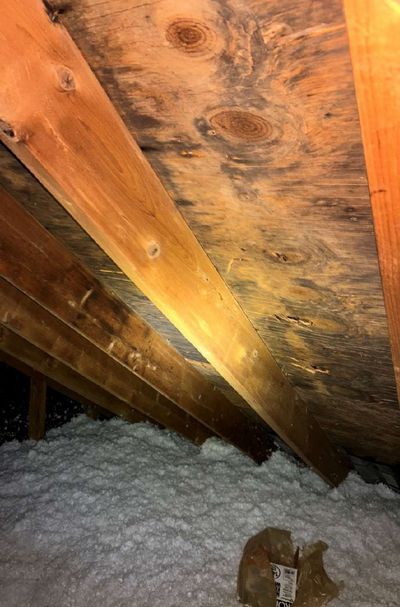
The report also covered the outside of the house, because attic and structural moisture usually starts at the exterior: keep gutters and downspouts clean and aligned, maintain a positive grade around the foundation and add drainage if needed, trim vegetation back from the walls, and have any plumbing leak or water infiltration repaired within twenty four hours. On sizing, the report cited the EPA guidance that any area of discoloration about three feet by three feet or larger should be properly remediated.
What Lafayette Hill Homeowners Should Know About Mold Testing
The lesson from this Wagner Road test is simple. A clean air sample does not mean there is no mold, and a visible stain does not always show up in the air. The two tests answer different questions, and the right scope depends on what you are actually trying to find out. If you have visible discoloration, the surface swab is what confirms whether it is mold and what kind. If you are worried about the air your family breathes, the air grab is what measures that. Sometimes, like here, you want both, because they can disagree.
Older attics in Lafayette Hill, the rest of Whitemarsh Township, and neighboring Flourtown are especially worth a look, because the combination of modest original ventilation, cold winters, and added insulation is the exact recipe for condensation on the roof sheathing. If you have noticed dark staining on your attic deck, a musty smell upstairs, or a bath fan that vents into the attic instead of outside, testing the discoloration directly is a straightforward way to know what you are dealing with before it spreads or degrades the framing.
Testing identifies and quantifies the problem. Remediation is a separate step handled by a qualified contractor. What a good mold test gives you is an honest, lab-backed picture of what is there, so the money you spend fixing it is spent on the right thing.
Bob Klebanoff
Owner, All Seasons Home Inspections
610-348-6728 | Free Estimate
Mold Testing in Lafayette Hill and the Surrounding Area:
Lafayette Hill Plymouth Meeting Conshohocken Flourtown Chestnut Hill Wyndmoor