If you are buying a home in Philadelphia or the older suburbs around it, there is a good chance you will hear the words "knob and tube" on inspection day. It usually lands the same way: a pause, then the question every buyer asks me next: is that bad?
The honest answer is that it depends entirely on what has been done to it since 1925. I have inspected homes with original knob-and-tube in better condition than the amateur wiring some sellers installed last spring. I have also crawled into attics where someone blew a foot of cellulose insulation over active century-old conductors and created a genuine fire hazard nobody knew existed.
This guide is what I tell buyers standing in the basement with me. I inspect every home personally. There is no team, no hand-off, and no junior inspector showing up in my place. I photograph every accessible run of original wiring I find. The photos below are from my own inspections in the Philadelphia region.
What Knob-and-Tube Wiring Actually Is
Knob-and-tube was the standard method of wiring American homes from roughly the 1880s into the 1940s, and in this region you will find it in houses built well into the 1930s. It is easy to identify once you know the shapes.
Two components give it the name. Knobs are white porcelain spools nailed to joists and studs; the wire wraps around them so it is held in open air, never touching wood. Tubes are porcelain sleeves driven through joists and framing members wherever a wire has to pass through wood, so the conductor never contacts the timber.
The wire itself is the giveaway. Modern cable bundles its conductors inside one sheath. Knob-and-tube runs the hot and neutral as two entirely separate single conductors, often a foot or more apart, each wrapped in rubber and then a woven cloth braid. Splices were twisted, soldered, and taped by hand.
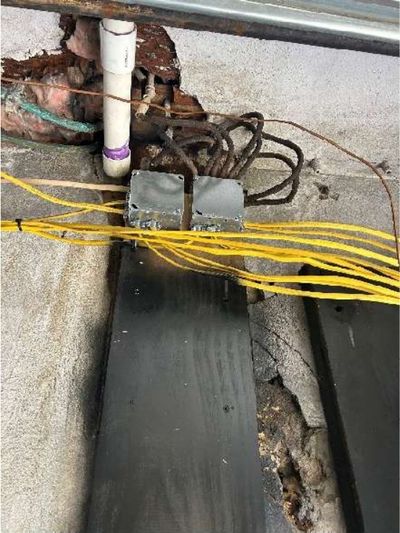
Most people get this part wrong: this was good engineering. Running conductors separately in free air let them dissipate heat efficiently, and the porcelain isolated them from anything combustible. Undisturbed, in a dry open basement, it can still be perfectly intact a hundred years later. The system did not fail. What failed is everything that happened to it afterward.
The Three Scenarios I Actually Find
In practice, knob-and-tube shows up in Philadelphia-area homes in three distinct patterns, and they carry very different consequences for a buyer.
1. Fully abandoned and disconnected
The house was rewired at some point, and the old porcelain and cloth remain stapled to the joists because pulling it out is labor nobody wanted to pay for. This is the best case and it is common. Dead K&T is a housekeeping item, not a hazard. The important word is verified: abandoned wiring should be confirmed de-energized, not assumed. I have found "abandoned" runs that were still live.
2. Partially rewired: the one that worries me
This is the scenario I see most often and the one buyers underestimate. Someone upgraded the service panel, replaced the visible wiring in the basement and kitchen, and left the original circuits feeding the second floor and the bedrooms behind plaster. From the panel it looks modern. Behind the walls, it is 1925.
I have written this exact finding up more than once: a clean, new-looking breaker panel with original knob-and-tube conductors simply landed on the new breakers. The panel upgrade gives every appearance that the electrical system was addressed. It was not. A modern panel on original wiring is a cosmetic upgrade, and it is a trap for anyone who looks only at the panel cover.
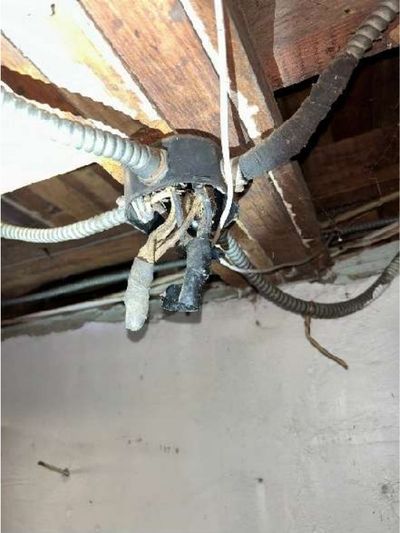
3. Active, original, and buried under insulation
This is the genuinely dangerous one. Sometime in the last forty years, in the name of energy efficiency, someone blew cellulose or fiberglass into the attic floor or the wall cavities, directly over live knob-and-tube.
Remember why the system worked: the conductors shed heat into open air. Pack insulation around them and that heat has nowhere to go. It accumulates against rubber insulation that has been getting brittle since the Truman administration. This is the specific condition that turns century-old wiring into a fire risk, and it is why modern code prohibits thermal insulation in contact with active K&T.
When I find blown-in insulation in an attic of a home old enough to have original wiring, I am moving insulation aside to look underneath. It is one of the highest-value things I do in an older home, and it is invisible from the hatch.
Why It Matters Beyond Fire Risk
Two consequences of knob-and-tube have nothing to do with fire, and they affect buyers more often.
There is no ground. Knob-and-tube is a two-wire system with no equipment grounding conductor. That means every three-prong outlet in the house is either fed by newer cable or is providing no ground at all: the third slot connects to nothing. I test for this, and finding ungrounded three-prong receptacles on original circuits is routine. It matters for surge-sensitive electronics, for appliances that expect a ground path, and for anyone assuming their outlets are protected.
The circuits were designed for a 1925 electrical load. A house wired in the twenties was built to run a few lights and maybe a radio. It was never designed for a modern kitchen, window air conditioning, home offices, and the dozen things now plugged in on every floor. Older homes on original circuits frequently show the symptoms: a small number of circuits covering entire floors, and the tell-tale evidence of overloading.
Insurance Is the Problem Buyers Do Not See Coming
In my experience this derails more transactions than the safety question does: many insurance carriers will not write a new homeowners policy on a house with active knob-and-tube. Others will bind coverage only on the condition that the wiring is removed within a defined window after closing. Some will write it at a higher premium with an electrician's letter. Carriers vary enormously, and the underwriting position can differ between two companies on the same street.
The failure mode is always the same and it is a timing failure. The buyer finds out about the wiring at inspection, assumes it is a negotiating item, and does not call their insurance agent until after the inspection contingency has expired. By then the leverage is gone and the coverage problem is theirs.
If I find active knob-and-tube in your home, call your insurance agent that day. Not next week. It is a five-minute phone call that determines whether you have a negotiation or a crisis.
What Rewiring Actually Costs Around Philadelphia
Buyers ask me for a number, and I am careful here, because I am an inspector and not an electrical contractor: the real number comes from a licensed electrician who has walked the house.
That said, for a typical Philadelphia row home or a modest twin, whole-house rewiring commonly lands somewhere in the range of roughly $8,000 to $15,000. Larger stone colonials, Victorians, and Main Line homes with plaster walls and three floors run well past that.
The variables that move the number most:
- Plaster-and-lath versus drywall. Fishing cable through plaster is slower and the patching bill afterward is real.
- Accessible attic and basement. An open, walkable basement and a full attic give an electrician routes. A finished basement and a low crawl space remove them.
- Number of floors. Each additional floor multiplies the vertical runs.
- Whether the panel goes too. Rewiring often surfaces the need for a service upgrade, and that is a separate line item.
- Partial versus whole-house. Replacing only the remaining active K&T circuits is frequently far less than a full rewire, and it is often the right scope.
Get two quotes. Estimates given over the phone without seeing the house are not quotes, and negotiating against a guess is how buyers leave money on the table.
Where I Find It in the Philadelphia Region
Knob-and-tube tracks housing age, so it follows the map of where this region built first. I encounter it most in the older Philadelphia neighborhoods: Germantown, Mt. Airy, Chestnut Hill, Roxborough, Fishtown, and Northern Liberties, where much of the stock predates 1930.
It is equally common in the first-ring older suburbs. Cheltenham, Jenkintown, and Wyncote have large inventories of pre-1930 homes, and on the Main Line the stone colonials and Victorians through Ardmore, Narberth, and Bala Cynwyd are exactly the vintage. Lansdowne and the older Delaware County boroughs are the same story.
If a home in these areas was built before about 1940 and has never been documented as fully rewired, I approach it assuming original wiring is present somewhere until I can establish otherwise.
What I Do About It on an Inspection
A home inspection is visual and non-invasive, and I am direct with buyers about where that boundary sits. I cannot see inside finished walls, and no inspector can tell you with certainty how much original wiring remains behind plaster.
What I do is thorough within that scope. I examine the panel and identify what is actually landed on the breakers. I go through accessible basements, attics, crawl spaces, and open joist bays. I move attic insulation to look underneath in homes old enough to warrant it. I test receptacles for grounding. I look hard at transition points where old wiring meets new, because that is where the improvised work concentrates. And I photograph every run I can reach, so you have documentation to hand to an electrician and to your insurance agent.
When I find active knob-and-tube, my recommendation is an evaluation by a licensed electrician. That is not me passing the problem along. It is the correct next step, because tracing circuits and opening devices is genuinely outside what a home inspection is.
The Bottom Line
Knob-and-tube wiring is not automatically a reason to walk away from a house. In a region with housing stock this old, that standard would rule out a large share of the neighborhoods people most want to live in.
What it is, always, is a condition you need scoped before your contingency expires. Know whether it is live. Know whether insulation is sitting on it. Know what your insurer will do. Get real quotes. Then negotiate with numbers instead of anxiety.
The buyers who get hurt are not the ones who bought a house with old wiring. They are the ones who found out how much of it was still live after they owned it.
If you are under contract on an older home anywhere in the Philadelphia region and you want someone who will actually get into the attic and look under the insulation, call or text me at 610-348-6728. I do every inspection myself, and I will show you exactly what is up there.
Home Inspection in Older Philadelphia-Area Neighborhoods:
Philadelphia Germantown Mt. Airy Chestnut Hill Cheltenham Jenkintown Ardmore Roxborough