Leaks and mold were among the conditions renters described to City Council while the bills were debated, alongside pests, lack of heat and falling ceilings (Philadelphia Inquirer, March 4, 2026). The ordinance that came out of those hearings is about licenses, certificates and deadlines. Everything below about the law comes from the certified copy of the bill, with the section numbers, so you can check it yourself.
What changes on November 1, 2026?
Bill No. 250329, passed by City Council on April 23, 2026 and signed by the Mayor on May 7, 2026, amends the city's rental licensing chapter. From November 1, an owner attests that a unit is free of unfit, unsafe or imminently dangerous conditions, tenants gain new ways to ask for proof, and an owner who misses a correction deadline can lose the right to collect rent for that period.
The parts that matter for a water problem, as written in the certified copy of Bill No. 250329:
- The attestation. To get a Certificate of Rental Suitability, the owner states that the operating systems work and that the premises are free of unfit, unsafe or imminently dangerous conditions. The tenant receives a copy of that statement (§ 9-3903).
- Certificates on request. A tenant may ask the owner for a Certificate of Rental Suitability once in any 90-day period. The owner has 10 days to provide one issued within the previous 30 days, and cannot collect rent until it is provided (§ 9-3903(1)(d)).
- The 30-day clock. An unsafe, unfit or imminently dangerous violation that is not corrected within 30 days of the notice of violation, or sooner if L&I says so, counts as noncompliance unless it is under timely appeal (§ 9-3903(2)(d)). An owner in noncompliance cannot collect rent or recover possession for that period (§ 9-3901(4)(h)).
- The burden of proof. In an eviction or rent case, the owner has the burden of demonstrating compliance during the tenancy (§ 9-3903(2)(d)).
- Damages. A tenant who prevails in a private action can recover compensatory damages or $1,000 per violation, whichever is greater, plus reasonable attorney's fees and costs (§ 9-3901(4)(i)).
The city explains the Certificate of Rental Suitability on its rental suitability page.
Does the Safe Healthy Homes Act mention mold?
No. Bill No. 250329 never uses the words mold, moisture or leak. It is written around code violations that L&I classifies as unfit, unsafe or imminently dangerous. There is no federal pass or fail number for mold either: the EPA says standards for airborne mold "have not been set" (EPA, Mold Testing or Sampling).
That gap is why moisture disputes are hard to settle. A landlord can say a leak was repaired. A tenant can say the smell never left. Neither statement is evidence. What settles it is whether the material is dry, whether the water source is closed, and what a lab finds in a sample.
When do the city's proactive inspections start?
Not on November 1. The Act authorizes L&I to establish a Proactive Inspection Program with the goal of inspecting licensed rental properties on a regular cycle by July 2030, where such inspections are feasible. The first progress report to Council is due by December 31, 2027 (§ 9-3903(2)(e) and (f)).
For the next few years, then, the practical effect of the Act is on paperwork and proof, not on an inspector arriving unannounced. Inspections still begin with a complaint.
What should a landlord keep on file after a leak?
Keep proof that the water stopped and the material dried, not only an invoice. The Act's safe harbor for an owner waiting on a city re-inspection asks the owner to show that the underlying condition was corrected on time and that the tenant was notified of the completed repair (§ 9-3901(4)(j)). For a leak, that means dated repair records, a moisture reading after drying, photos, and a lab result where there was visible growth.
In August 2026 Bob tested a kitchen in a managed rental in Manayunk where past water infiltration had been reported as already remediated. The ceiling was patched and repainted. A section of it still measured wet on a moisture meter. The air sample came back normal, which did not mean the problem was solved. It meant the moisture had not yet become an air quality problem.
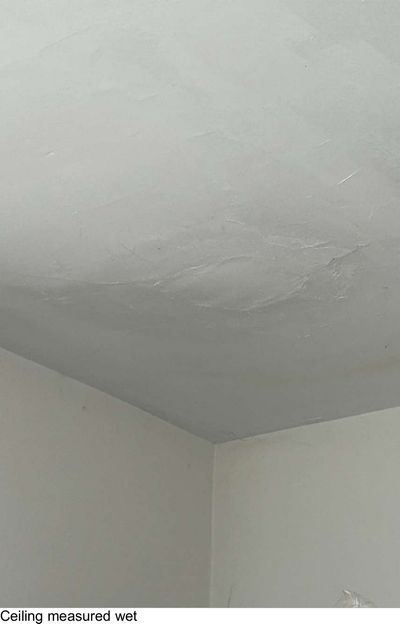
That is the difference between a repair that is recorded and a repair that is verified. Under rules that put the burden of proof on the owner, the second one is worth having.
What should a tenant do about mold or a leak?
Report it to the landlord in writing first, with the date, the location and photos. If it is not addressed, report it to L&I through Philly311. A notice of violation from L&I is what starts the Act's 30-day correction clock. A private mold test is optional and often not needed.
If you can see the mold and you know where the water is coming from, you usually do not need a test. The EPA's guidance is that "in most cases, if visible mold growth is present, sampling is unnecessary" (EPA, Mold Testing or Sampling). The fix is to stop the water and remove the growth. A test is worth paying for when there is a musty smell with no visible source, when symptoms persist, or when a repair is called finished and the result is disputed. Our guide Do You Need a Mold Test? walks through that decision.
Where does independent mold testing fit, and where does it not?
A private test is evidence, not a ruling. It is not an L&I inspection, it is not a Certificate of Rental Suitability, and the Act does not require one from anyone. What it gives either side is a dated record backed by a lab: moisture readings, air samples, and surface samples where growth is visible.
Who performs the test matters. A company that also sells remediation has a financial stake in what the test finds. All Seasons tests only and never does remediation, for landlords, property managers and tenants alike, in Germantown, Roxborough, Chestnut Hill and across the city. Bob collects every sample personally, and PRO-LAB certified results come back in 2-3 business days. Mold and air quality testing starts from $290.
Is the law settled?
Not entirely. Two rental property owners sued over the bills in March 2026. A judge allowed the Council vote to go ahead, and the case was still open when the Mayor signed the bills on May 7, 2026 (Philadelphia Inquirer, May 7, 2026). The ordinance as signed takes effect November 1, 2026.
We have not found a final ruling in that case as of October 2, 2026. Check current reporting or a lawyer before relying on any single provision. Only Bill No. 250329 is covered here. The Safe Healthy Homes package includes other bills, on retaliation and relocation, that this guide does not describe.
Sources
- Bill No. 250329-AA, certified copy, City of Philadelphia
- City of Philadelphia, Rental suitability
- City of Philadelphia, Submit a service request with 311
- U.S. EPA, Mold Testing or Sampling
- The Philadelphia Inquirer, April 23, 2026
Need a Repair Verified or a Smell Explained?
All Seasons provides PRO-LAB certified mold testing and air quality analysis for Philadelphia rentals, starting from $290. Testing only, never remediation. Bob personally collects all samples. Results in 2-3 business days. Call 610-348-6728.
Mold Testing in Northwest Philadelphia:
Manayunk Roxborough Germantown Chestnut Hill Mt. Airy East Falls Philadelphia