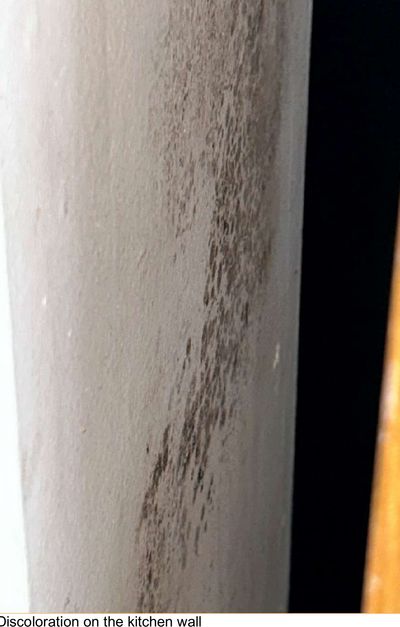
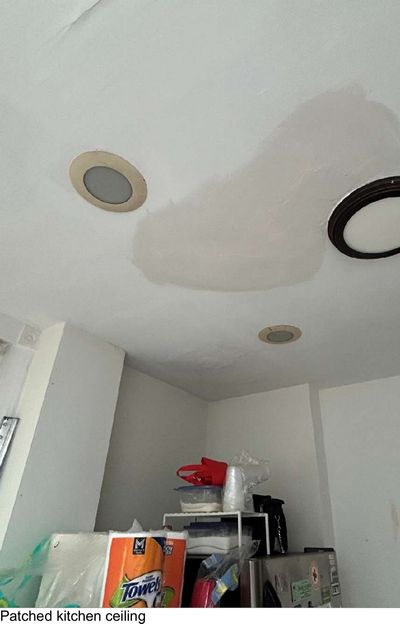
In late August 2026, I was asked to test a kitchen in a managed rental property in Manayunk for a property management company. The kitchen had a history: past water infiltration there had been reported as already remediated. There was discoloration on the wall behind the pantry cabinet, and the ceiling showed blistered, patched areas from an earlier repair.
That combination, a reported repair plus visible cosmetic patching, is exactly the situation where a moisture meter earns its keep. A patch and a coat of paint change how a ceiling looks. They do not, by themselves, prove the water source behind them was found and stopped. When I checked the blistered section of the ceiling, it still measured wet. Here is what that meant, and what the lab found when I sampled the air.
1. Discoloration on the Kitchen Wall Behind the Pantry
The wall behind the pantry cabinet had a pattern of dark, streaked discoloration running down toward the floor. It is the kind of thing that is easy to miss because it sits behind furniture, in a spot nobody looks at unless the cabinet gets pulled out.
2. A Blistered, Patched Kitchen Ceiling
The kitchen ceiling had blistered sections where an earlier repair had been patched in around one of the recessed lights. Blistering like this happens when paint and joint compound stop bonding to what is underneath, and moisture is the usual reason a patch fails to hold cleanly.
3. The Section That Still Measured Wet
This is the finding that made the test worth writing up. I checked the blistered ceiling with a moisture meter, and a section of it measured wet. Not stained-looking. Not "may have been damp once." Wet, on the meter, in the present.
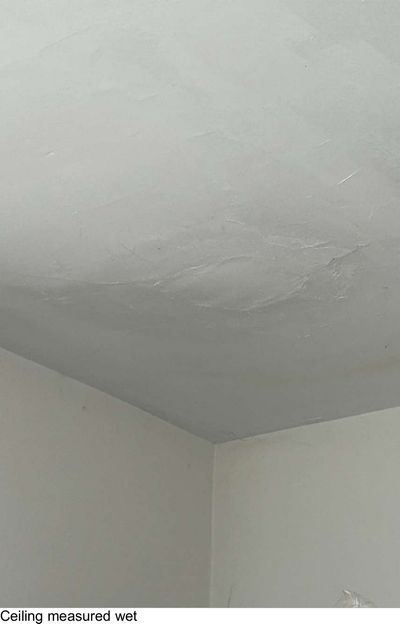
That is the gap between "remediated" as a status on a work order and "remediated" as a verified fact. Someone reported the leak as fixed. The ceiling was patched and repainted, which looks like fixed. But a current moisture reading on the same ceiling section says water is still getting in, or never fully dried out to begin with.
4. Why "Reported as Remediated" Is a Claim, Not a Fact
For a property management company, repair history on a rental unit is almost always secondhand. A prior contractor did work, someone logged it as complete, and the file says remediated. Nobody at the management company watched the actual repair happen or reopened the ceiling to confirm the source was found. That is not a criticism of anyone in that chain. It is just how property management works across multiple units and multiple vendors.
The problem is that a status field in a maintenance system is not the same thing as a verified fact on the ground. A moisture meter is a fast, neutral way to check whether "remediated" holds up. In this kitchen, it did not. The right conclusion is not that the earlier repair was necessarily done badly. It is that whatever was done did not fully resolve the water source, and the ceiling condition today is proof of that, independent of what the paperwork says.
5. The Air Grab, and Why the Lab Came Back Normal
Along with the moisture check, I took an air grab in the kitchen. The lab result came back Normal Mold, meaning a typical, expected level and mix of spores in the air on the day of the test. That is a good result, and it should be read honestly as one. This is not a story about a health emergency.
It is a story about an unresolved moisture source that has not yet, or not fully, turned into an air quality problem. Mold needs sustained moisture and time to establish and grow enough to show up as elevated in an air sample. A ceiling that is currently wet but has not been that way indefinitely can produce a Normal air result today and a very different one months from now if the water source is never actually fixed. The wet ceiling and the clean air sample are not in conflict. They describe two different points on the same timeline.
6. The Recommended Next Steps
Testing tells you what is happening. It does not fix it. Based on these findings, the report recommended having a qualified contractor further evaluate the kitchen, actually remediate the water infiltration this time, rather than re-patching the surface, and remove the affected mold material.
The broader moisture recommendations for the property were to keep vents clean, add humidity control and HEPA filtration in occupied rooms, keep gutters and downspouts clean and properly aligned, maintain positive grade around the foundation so water drains away from the building rather than toward it, and trim vegetation back from the exterior walls. Manayunk's rowhomes and multi-unit buildings sit close together on sloped lots along the Schuylkill, and grading and gutter maintenance carry real weight in whether water ends up against a foundation or a kitchen wall in the first place.
What Manayunk Landlords, Property Managers, and Tenants Should Know
The lesson from this Manayunk kitchen is not that every past repair is suspect. It is that "remediated" is a status, and a moisture meter is how you check whether the status matches reality. This ceiling had been patched. It had been repainted. On paper, the leak was done. On the meter, a section of that same ceiling was still wet.
That gap matters most exactly where it showed up here: a rental unit, managed at arm's length, where the person deciding whether a repair is complete usually was not present for the repair itself. If you manage or own rental property in Manayunk, Roxborough, or elsewhere in Philadelphia and a unit has a history of water infiltration, a "remediated" note in the file is a claim worth verifying before you close the ticket, especially between tenants. The air and moisture readings are fast, and the report gives you something to hand to the next contractor, or to file, that is more than someone's word.
For Philadelphia rentals this matters more from November 1, 2026. The city's Safe Healthy Homes Act puts the burden on the owner, in a rent or eviction case, to show compliance. What the ordinance says, and where a moisture reading fits.
If you want a rental property or a unit tested, schedule a mold test with All Seasons. I personally perform every test and write every report.
Bob Klebanoff
Owner, All Seasons Home Inspections
610-348-6728 | Free Estimate
Mold Testing in Manayunk and the Surrounding Area:
Manayunk Roxborough East Falls Germantown Chestnut Hill Mt. Airy Philadelphia