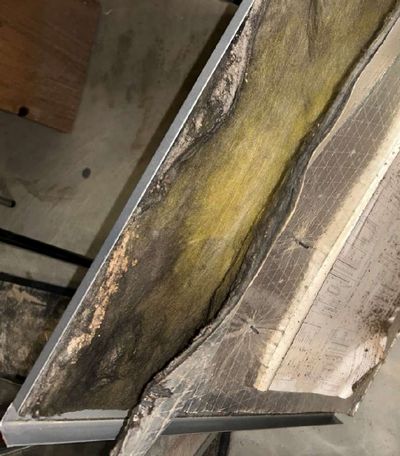
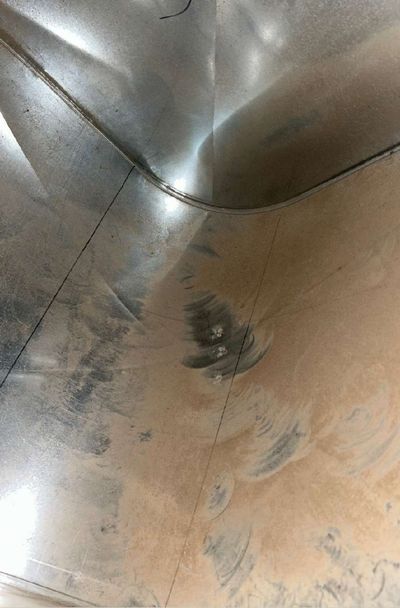
In November 2026 I tested a home in Malvern with two HVAC systems, one serving the lower level and one serving the upper level. Mold was noted on the AC coils, so instead of sampling two rooms, I took the air samples right at each coil, plus a third sample outdoors for comparison. Both coil samples came back Elevated.
The coil is the part of the system most homeowners never see. It sits inside the air handler cabinet, behind a panel, past the filter you change. Below are the questions people ask me about AC coil mold, answered with what the lab found in this house and what my other HVAC tests have shown.
Can mold grow on an AC coil?
Yes. The evaporator coil inside your air handler runs cold during the cooling season, so water condenses on it every time the air conditioning runs. Dust pulled in from the house sticks to that wet surface, and the cabinet around it is dark. Damp, dark, and fed with dust is the setting mold needs. In this Malvern home, mold was noted on the coils of both systems.
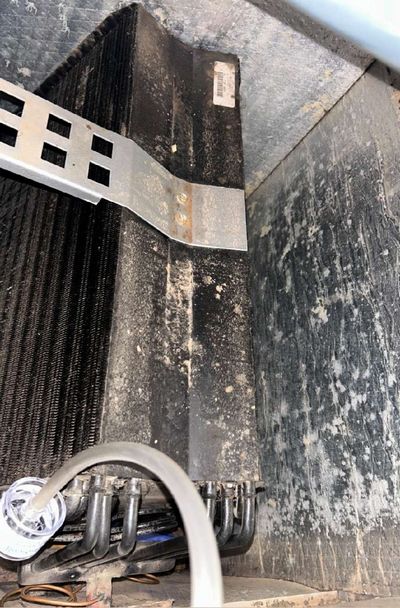
What did the lab find at the two Malvern coils?
Both coil samples came back Elevated. The lower-level coil measured 2,373 spores per cubic meter, almost all of it Cladosporium. The upper-level coil measured 1,787, and a third of that was Penicillium/Aspergillus. The outdoor control sample, taken the same day, measured 1,288 and had a very different mix of spores.
| Sample | Total spores/m³ | Cladosporium | Pen/Asp | Basidiospores | Hyphal frag./m³ |
|---|---|---|---|---|---|
| Lower coil | 2,373 | 2,240 (94%) | 80 (3%) | 53 (2%) | 293 |
| Upper coil | 1,787 | 880 (49%) | 587 (33%) | 240 (13%) | 13 |
| Outdoors | 1,288 | 373 (29%) | 107 (8%) | 640 (50%) | none detected |
Pen/Asp is Penicillium/Aspergillus, which the lab reports together. Each sample was 150 liters of air drawn through a spore-trap cassette at 15 liters per minute for 10 minutes on November 4, 2026. An AIHA-accredited lab analyzed them by direct microscopy and reported the results two days later. The table shows the main spore types. Small counts of other types, such as Ascospores, make up the rest of the upper-coil and outdoor totals.
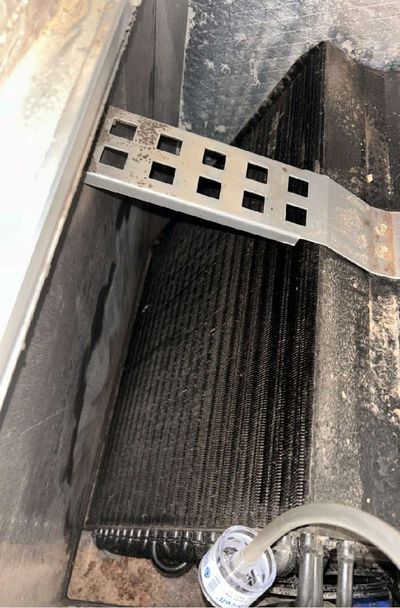
Why compare the coil sample to an outdoor sample?
Because outdoor air always carries mold spores, and the outdoor sample shows what normal looks like that day. When an indoor sample matches the outdoor mix, the spores are probably coming in from outside. When the indoor mix looks different, with one type far above its outdoor level, that points to a source indoors.
Here the difference was plain. Outdoors, Basidiospores led at 50% of the count and Cladosporium was 29%. At the lower-level coil, Cladosporium was 94% of the count: 2,240 spores per cubic meter against 373 outdoors, about six times the outdoor level. At the upper-level coil, Penicillium/Aspergillus measured 587 against 107 outdoors, more than five times higher.
The lower-level coil sample also held 293 hyphal fragments per cubic meter, and none were detected outdoors. Hyphae are the threads a mold colony is made of, as opposed to the spores it releases. Finding pieces of them in the air at the coil, and not outdoors, fits with what the report noted: mold on the coil itself.
One honest caution about the totals. The reference guide in my reports puts 1,000 to 3,000 spores per cubic meter in its Elevated band, and the outdoor sample that day, at 1,288, falls in that band too. A total alone would not prove much here. The case for a coil problem rests on what the spores were, how they compared to outdoors, and the growth visible on the coils.
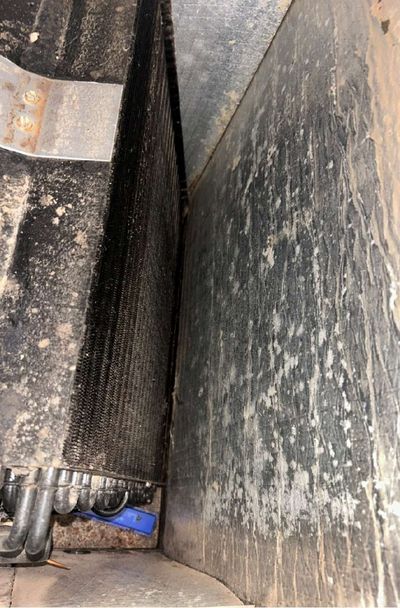
Is mold on an AC coil dangerous?
It is worth taking seriously, because the coil sits directly in the airstream, so whatever grows there is in the air your system delivers to every room. On this Malvern home the report recommended having a qualified contractor further evaluate and remediate the mold to reduce the risk of a health hazard. How it affects any one person varies.
The reference guide included with my reports, which cites ACGIH and AIHA guidance and clinical literature, gives thresholds for some mold types: 3,000 spores per cubic meter for Cladosporium, and 500 for Penicillium/Aspergillus. The lower-level coil's Cladosporium, at 2,240, was under its threshold. The upper-level coil's Penicillium/Aspergillus, at 587, was over its threshold of 500. The guide notes that elevated Cladosporium levels are linked to allergic rhinitis and asthma.
Neither coil sample showed Stachybotrys or Chaetomium. Those are the two types the guide says are not found in normal outdoor air, so any indoor detection points to an active indoor mold problem. They have turned up in my other HVAC tests, which is one more reason the system is worth sampling.
Why is the AC coil so rarely tested?
Mostly because nobody asks. The areas sampled on a mold test are chosen at the customer's request, and people ask about the room that smells or the stain they can see. The coil sits inside a closed cabinet, behind a panel past the filter, so most homeowners have never seen theirs, and it rarely comes up.
My own files show it. I went back through 21 of my recent mold reports, from September 2025 to November 2026. Twelve of them sampled some part of the HVAC system, almost always the central return duct. This Malvern job is the only one of the 21 where the air sample was taken right at the coil.
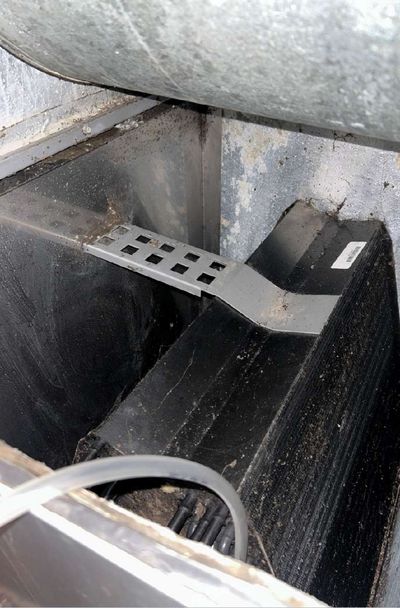
What have Bob's other HVAC mold tests found?
Across the 12 recent reports where I sampled part of the HVAC system, 4 came back elevated or with unusual mold, and 8 came back normal, not elevated, or with minimal growth. Twelve is a small number, so read these as what my own reports show, not a rate for homes in general. Here is the full list.
Elevated or unusual mold (4 of 12):
- Malvern: air at both AC coils, Elevated (this post).
- Ambler: air in the central return duct, Elevated, with Stachybotrys present. Ambler case study
- Haddon Township, NJ: air in the basement and the central return, Elevated. Haddon Township case study
- Elkins Park: swab of discoloration on the central return duct and coil in an apartment, unusual mold present. Elkins Park case study
Normal, not elevated, or minimal growth (8 of 12):
- West Chester: return air normal and a central humidifier swab with minimal growth, while discoloration was noted on the AC coil, which was not sampled. West Chester case study
- Exton: air in the central return and the attic, Normal. Exton case study
- Chestnut Hill: swab of a condo mini-split unit, very low or minimal growth. Chestnut Hill case study
- Ardmore: swab of the basement return register, scattered spores and no growth. Ardmore case study
- Kennett Square and Lafayette Hill: return air not elevated.
- A veterinary hospital and an office building: return air not elevated, though both had mold found elsewhere by swab.
The West Chester result is the one to remember. The air at the return was normal, and the coil still had visible discoloration and was recommended for cleaning. A return sample measures the air coming back from the house before it reaches the coil, so a normal return does not clear the coil.
What should you do if your AC coil has mold?
Have a qualified contractor evaluate and clean or remediate the coil, and fix whatever keeps it wet. On this Malvern home the recommendation was further evaluation and remediation by a qualified contractor, along with keeping the HVAC air filter and ducts clean, increasing humidity control, and dehumidifying during the warm months of the year.
I test only. I don't clean coils, do remediation, or refer cleanup for a fee, so my result is not tied to a quote for the fix. After the work is done, a post-remediation clearance test is how you confirm the coil and the air came back down, instead of taking it on faith.
When should you ask for an AC coil sample?
Ask for one when the smell, the stain, or the history points at the HVAC system: a musty odor that shows up when the air conditioning runs, visible growth when you open the filter door, a past condensate leak, or a home with more than one system. Each system has its own coil, and in this house the two came back different.
A standard mold test includes two indoor air samples and an outdoor control. In this Malvern house, the two indoor samples went to the two coils instead of two rooms. If you also want a room or a stain sampled, that is an added sample; current prices are on the pricing page.
What Malvern homeowners should know
If your home has two HVAC systems, like this one in Malvern, treat each coil as its own question. Here the lower-level coil was dominated by Cladosporium and the upper-level coil by Penicillium/Aspergillus, so a single sample at one coil would have missed half the picture.
I test homes across Malvern, Paoli, Berwyn, and Exton. If the musty smell comes on with the air conditioning, ask me to sample at the coil. I personally perform every test and write every report.
Bob Klebanoff
Owner, All Seasons Home Inspections
610-348-6728 | Free Estimate
Mold Testing in Malvern and the Surrounding Area:
Malvern Paoli Berwyn Devon Wayne Exton West Chester Chesterbrook